Legacy Admissions at Ivy League Universities and Career Outcomes
Legacy preferences give wealthy families a five-fold admissions boost at Ivies.

- Written by
- Kwame Osei-Bonsu
- Published
- October 15, 2026
- Reading time
- 10 min read
- Sources cited
- 6 sources ↓
What this covers
- What legacy admissions actually is and how it operates inside Ivy League admissions
- How the legacy advantage compounds with wealth and concentrates among families already at the top
- What an Ivy League degree actually delivers in career terms
- Legacy status predicts getting into the network but not performing better within it
Legacy admissions is not a ceremonial nod to family tradition. It is a quantifiable structural advantage in the Ivy League admissions process, one that shapes who receives the single most career-valuable credential in American higher education. The data from the SFFA v. Harvard trial and the Opportunity Insights 2023 study show that the preference operates less as the tiebreaker universities describe and more as a multiplier, concentrated among families already at the top of the income distribution. The result is that legacy preference functions as a career-sorting mechanism, not merely an enrollment one.
What legacy admissions actually is and how it operates inside Ivy League admissions
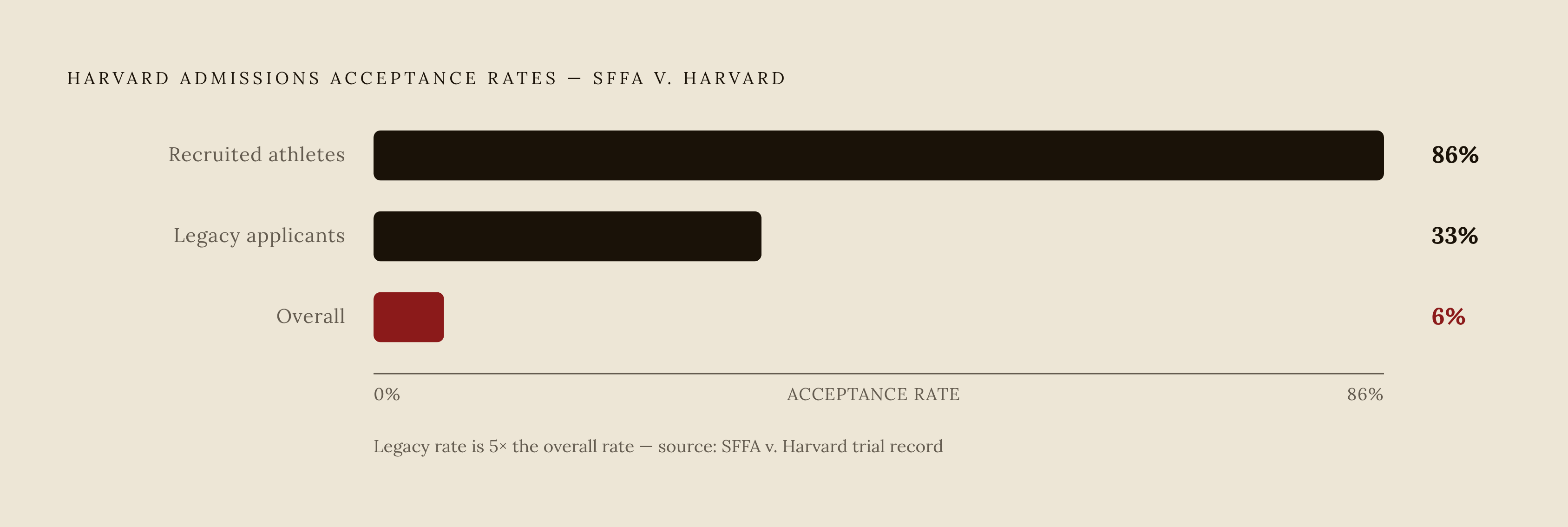
The public defense of legacy admissions typically frames it as a marginal consideration, a way to distinguish between otherwise identical applicants when all other factors are equal. At Harvard, legacy applicants were admitted at roughly 33 percent during the period covered by the SFFA v. Harvard trial disclosures, more than five times the overall acceptance rate during the same window. If legacy status functioned only as a tiebreaker, the share of legacy students in admitted classes would not consistently exceed overall acceptance rates by multiples. It does.
The practice sits inside a broader system of institutional preferences known collectively as ALDC: Athletes, Legacies, Dean's Interest List, and Children of faculty and staff. The acronym entered public view only because the SFFA v. Harvard litigation forced internal admissions data into the open. Those disclosures showed that ALDC applicants were a small fraction of Harvard's applicant pool, but they accounted for roughly a third of admitted students. Recruited athletes were admitted at roughly 86 percent. Legacy applicants sat at the low end of that privileged grouping, at approximately 33 percent, which was still far above the general rate.
Harvard's class of 2027 was roughly 32 percent legacy students. All eight Ivy League schools, Brown, Columbia, Cornell, Dartmouth, Harvard, Princeton, the University of Pennsylvania, and Yale, still considered legacy status as of 2026. The others had made no formal announcement of that kind.
How the legacy advantage compounds with wealth and concentrates among families already at the top
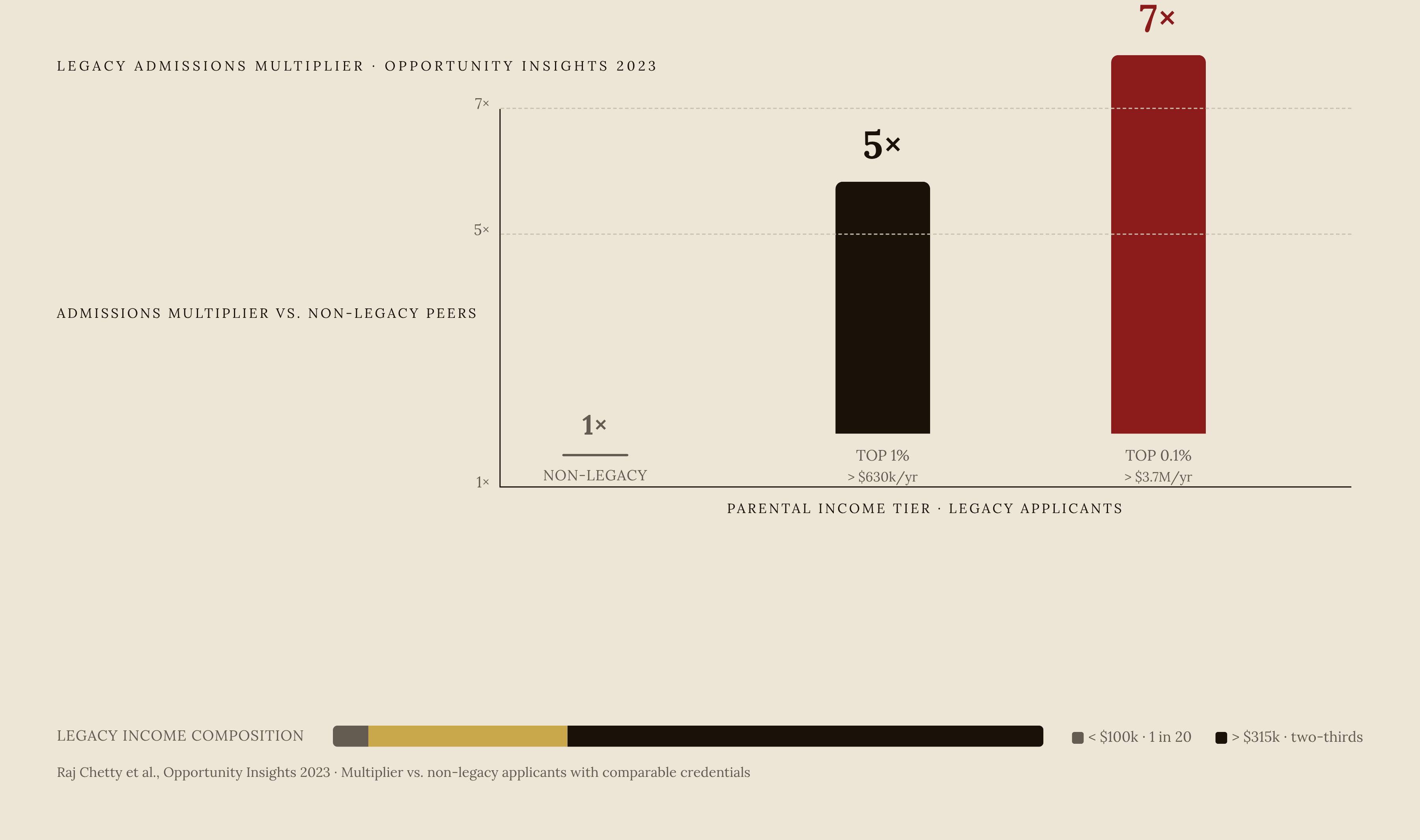
The legacy advantage does not distribute evenly across applicants. The families least in need of extra help gaining entry to elite institutions get the strongest boost. The Opportunity Insights study by Chetty, Deming, and Friedman, published in 2023, quantified this concentration. Top-1-percent-income legacy applicants were five times more likely to be admitted than peers with comparable credentials.
The income composition of legacy applicants explains much of that disparity. Two-thirds of legacy applicants to Ivy-Plus universities come from families earning more than $315,000 per year. Only one in twenty legacy applicants comes from a family earning $100,000 or less. At the very apex of the distribution, the advantage grows further: legacy applicants in the top 0.1 percent of parental income are seven times as likely to be admitted as applicants with the same test scores. What this means is that a preference theoretically available to any child of an alum in practice channels access toward a narrow band of wealthy families, because those families are the ones whose parents attended these schools in earlier generations.
Racial disparities follow directly from that income skew. More than half of white students have a college-attending parent, compared to roughly a quarter of Black students, a fifth of Hispanic students, roughly a fifth of American Indian and Alaska Native students, and roughly a third of Pacific Islander students. Legacy preference therefore structurally benefits white families relative to those groups. The groups least likely to have a parent who attended an Ivy League school are the same groups the legacy system most disadvantages. The post-affirmative-action context sharpens this dynamic. Harvard's fall 2024 undergraduate cohort was 14 percent Black, down from 18 percent the prior year after the affirmative action ban, but legacy preferences stayed intact. The university removed one equity tool while preserving a policy that actively operates in the opposite direction.
There is a counterpoint that deserves acknowledgment. The Opportunity Insights study found that legacy applicants are 33 percent more likely to be admitted even without consideration of their legacy status. But even conceding that overlap, the residual boost, the advantage over and above what qualifications alone would earn, remains large and concentrates at the very top of the income distribution. The credential overlap explains part of the disparity. It does not explain the full multiplier, and it does not address who receives the residual advantage.
What an Ivy League degree actually delivers in career terms
The population now inside the gates is wealthier, more heavily legacy-connected, and more likely to be white than the applicant pool as a whole. The next question is what that population gains by being there. The answer, from the Opportunity Insights 2023 study, is substantial. Attending an Ivy-Plus institution nearly doubles a student's chances of attending an elite graduate school. Those advantages go well beyond mere signaling. They represent access to a particular set of institutional and interpersonal resources that other schools do not provide at the same scale.
Those outcomes depend on networks, not just credentials. Alumni networks, the same networks that generate legacy applicants, operate as ongoing career accelerants long after graduation, through referrals, board seats, firm partnerships, and fundraising circles. Students who arrive already embedded in elite social structures are better positioned to activate them immediately, because they know the people who sit at the nodes of those networks and understand how to navigate them from their first semester.
The implication for the argument is direct. If an Ivy degree triples the chance of landing at a prestigious firm, and legacy preferences shape who receives that degree, then legacy admissions is a career-sorting mechanism, not just an enrollment one. The families who benefit from the preference are the families who already hold that network capital in the prior generation, which means the system functions as a conduit for passing economic advantage across generations rather than distributing it anew.
Legacy status predicts getting into the network but not performing better within it
The sharpest claim in the data is the one that dismantles the primary institutional defense of legacy admissions. That defense holds that legacy status selects for a certain quality, institutional loyalty, demonstrated family engagement, social maturity, that predicts future success and benefits the institution and its alumni network over time. The Opportunity Insights 2023 study shows that it does not. SAT scores and academic ratings predict better post-college outcomes, but legacy status does not. Legacy students reach the upper tail of earnings and elite graduate schools at equivalent or lower rates than non-legacy peers with comparable qualifications at the same institutions.
The data is consistent across outcome measures. The advantage is front-loaded entirely into the admissions decision. After that, the performance data looks the same or worse for legacies.
What legacy status does predict is access. It predicts access to the network, to the alumni infrastructure, to the downstream career machinery that an Ivy-Plus degree unlocks. Non-legacy students must build those relationships from scratch, often while also navigating the academic and social demands of an elite institution for the first time. But that objection explains only part of the advantage. The full multiplier, concentrated among the wealthiest applicants, cannot be explained by credentials alone, and the outcome data shows that admitting more legacy students does not improve the class's post-college performance.
What happened when schools removed the preference — the Johns Hopkins and Amherst evidence
The theoretical argument has empirical counterparts. Two institutions in elite higher education have served as natural experiments in the consequences of eliminating legacy preferences, and neither experienced the financial or academic collapse that institutional defenders predicted. Johns Hopkins University ended legacy consideration in 2014, the first top-20 school to do so. After the policy shift, legacy admissions in each freshman class decreased by roughly 9 percent, while students eligible for federal need-based grants increased by roughly 10 percent. Johns Hopkins simultaneously boosted need-based financial aid and expanded recruitment of low-income students, which suggests the outcome was not the automatic product of removing one lever but of reorienting several at once.
Amherst College followed a similar path. After eliminating legacy preferences, Amherst expanded enrollment of Pell-eligible and first-generation students, an outcome that skeptics had predicted was impossible without the alumni-giving pipeline legacy status was said to protect. The institution has never used legacy preference and states that it has not offered one in at least half a century. Its admissions blog clarified in October 2023 that a prior Common Data Set entry had erroneously reported a preference between 2004 and 2008. MIT's sustained academic reputation and fundraising success without legacy preferences undercuts the claim that the preference is necessary for institutional financial health.
The donor-pipeline objection is still the strongest institutional counterargument to legacy elimination. It holds that legacy preferences generate the alumni giving that finances financial aid, and that removing the preference would threaten the economic diversity that aid supports. A policy brief by Evans and Christensen published in April 2026 found something more nuanced. Banning legacy preferences does not consistently increase diversity across all institutions. Outcomes depend heavily on what else a school does simultaneously. What the Johns Hopkins and Amherst results suggest is that the donor-pipeline risk is manageable when combined with deliberate financial aid and recruitment reform. The outcome is a choice, not an inevitability.
How legislation, political pressure, and voluntary abandonment are reshaping the landscape in 2026
The broader higher education sector has moved substantially away from legacy preferences since 2015. More than 450 colleges have stopped considering legacy status in that period. Today, fewer than a quarter of four-year U.S. colleges consider legacy status at all. Schools that ended legacy admissions following the 2023 Supreme Court ruling include Carleton College, Loyola Marymount University, Occidental College, the University of Minnesota-Twin Cities, the University of Pittsburgh, Virginia Tech, and Wesleyan University. The practice is now the exception in American higher education, not the norm.
State legislation has accelerated that shift. Colorado, Maryland, Virginia, California, and Illinois have enacted bans on legacy admissions. Maryland's ban covers all colleges, public and private, receiving state funding, and took effect on July 1, 2024. California's ban, effective September 2025, covers private nonprofit universities as well. Federal legislative pressure has arrived more recently. A Senate bill introduced in March 2025, the Fair College Admissions for Students Act, would cut off federal student aid to colleges that give legacy or donor preference. In July 2026, a bipartisan group of senators introduced new federal legislation to ban universities from giving admissions preferences to children of alumni or donors. No federal ban has been enacted as of this article's publication.
The Supreme Court's 2023 decision ending affirmative action placed legacy admissions under heightened scrutiny. In October 2023, Yale president Peter Salovey said the university was asking whether legacy status was getting in the way of diversifying the applicant pool, with everything up for discussion. Brown president Christina H. Paxson formed a committee in September 2023 to reexamine legacy, early decision, and test-optional policies. As of 2026, no Ivy League school has formally eliminated legacy preference. The holdout is now anomalous, and the pressure to change is arriving from multiple directions simultaneously.
Why the Ivy League holdout matters specifically for career mobility, not just campus diversity
The Ivy League holdout is not a symbolic diversity issue. It is a mechanism for reproducing economic privilege across generations, and the reason lies in what an Ivy degree delivers. The Ivy-Plus effect on career outcomes is substantially larger than the effect at other institutions. The population-level consequence of legacy preferences at Ivies is therefore also larger than at institutions where the degree itself carries less career-sorting power. When a preference shapes who receives the highest-value credential in the system, the preference shapes who reaches the highest-value positions in the economy.
The network argument runs in both directions. Legacy students arrive already embedded in the alumni network, a resource their families helped build, and that network is what makes Ivy attendance so career-valuable. Non-legacy students, particularly first-generation and low-income students who would most benefit from that network, must compete for a smaller share of seats because legacy preferences occupy a disproportionate share of admitted classes. The career acceleration argument is not only about what legacy students gain. It is about what displaced non-legacy students do not get to access. The Opportunity Insights finding that legacy status does not predict better post-college outcomes, while Ivy attendance itself does, means the preference is not selecting for future leaders.
The holdout is a policy choice with distributional consequences. As the rest of higher education moves away from legacy preferences, the Ivy League's continued use of the practice concentrates the sector's highest-value network access in an increasingly narrow and demographically skewed population. Federal legislation targeting aid eligibility frames this as a public interest question: institutions receiving federal funding are using that funding to operate a system that advantages the already-advantaged. Johns Hopkins, Amherst, and MIT have demonstrated that universities can end the preference on their own. The unresolved question for the eight schools that still hold out is what happens to economic mobility in the country more broadly when the highest-value career networks in American life remain systematically more accessible to those already inside them.
Methodology & sources
- Ivy League Legacy Admission
Confirmed that all eight Ivy League schools still considered legacy status as of 2026.
- ALDC Preferences Ivy League: Legacy & Donor Advantage - Oriel Admissions
Provided details on the ALDC admissions framework and Harvard's post-affirmative-action enrollment figures.
- Legacy Admissions: Which Schools Still Consider It, How Much It Helps, and What Changed
Provided data on Johns Hopkins outcomes after eliminating legacy preferences, including the increase in need-based grant recipients.
- Diversifying Society’s Leaders? The Determinants and Causal Effects of
Primary source for quantitative findings on legacy admissions advantages, income concentration, and post-college outcome data.
- The impact of legacy status on undergraduate admissions at elite
Provided the specific Harvard legacy and athlete acceptance rate figures cited from SFFA v. Harvard trial disclosures.
- THE FUTURE OF FAIR ADMISSIONS ISSUE BRIEF 5: LEGACY ADMISSIONS IN 2025
Supplied the statistic that more than 450 colleges have stopped considering legacy status since 2015 and that fewer than a quarter of four-year colleges still consider it.