Elite Private School Networks That Feed Industry Access
Prep school choice shapes which elite universities—and careers—become reachable.

Does getting into a top university keep every professional door open afterward? Most families act as though the answer is yes, and they treat the college acceptance letter as the moment that sets a career's ceiling. That assumption skips a step. The university a student attends is itself conditioned by a choice a family makes years earlier, at age thirteen or fourteen, when it picks a secondary school. Elite private secondary schools work as the first stage of a layered pipeline that turns enrollment into professional opportunity, and the machinery behind that conversion starts running long before any college application gets filed. Families who ask only "what university will my child attend?" are asking half the question. Which secondary school positions a child for which pipeline matters more, since, as InGenius Prep's pipeline analysis puts it, elite undergraduate institutions are not interchangeable launchpads but distinct environments that align with different professional destinations, and the secondary school determines which of those environments a student can realistically reach.
How the architecture from prep school to industry is actually built
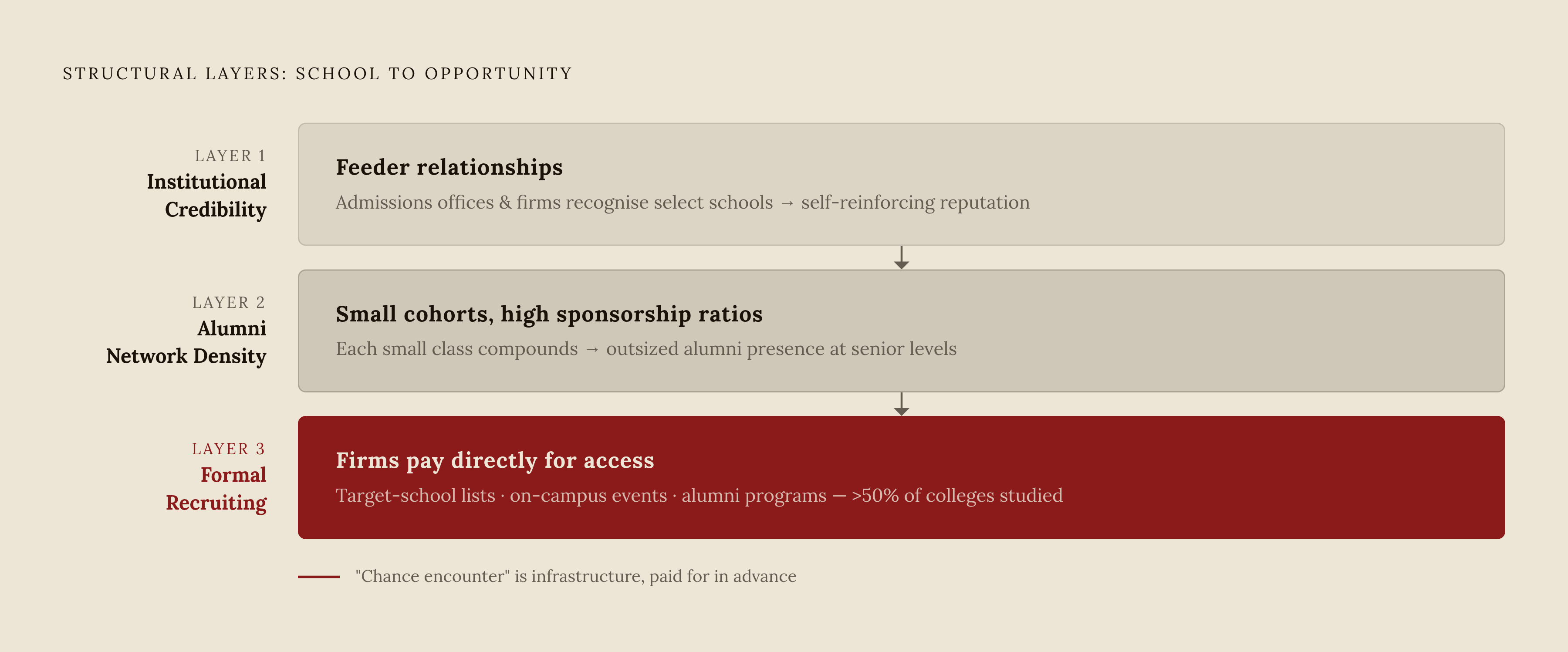
The pipeline runs on three layers that reinforce each other. The first is institutional credibility: secondary schools with established university placement records are known quantities to admissions offices, and that familiarity builds a feedback loop in which a school's reputation is partly a function of where its graduates already go. This is not a recent invention. The St. Grottlesex schools built deliberate relationships with leading universities, and they found an ally in Harvard president Charles Eliot, who distrusted public high schools. The architecture has roots that run back more than a century, not a marketing strategy bolted onto modern boarding schools. Harvard's own international pipeline data shows what that familiarity produces at scale: within the countries that send the most applicants, a concentrated subset of high schools controls access, and a student from a regional, non-feeder public school has to clear the ordinary acceptance bar while also competing against peers whose schools have spent years building a working relationship with the admissions office.
The second layer is alumni network density, and its mechanics are mostly a matter of arithmetic. Elite secondary schools and the smaller colleges that mirror their model graduate modest class sizes year after year, so when alumni reach senior positions in a firm or industry, the ratio of potential sponsors to new graduates runs far more favorably than it does at large universities. A firm with many senior employees who share a small alma mater, and a small annual output of new graduates from that same school, creates a sponsorship ratio that compounds over an entire career. InGenius Prep's analysis bears this out at the college level: enrollment-adjusted placement rates show that smaller colleges often outperform much larger universities at delivering graduates into specific professional destinations, because alumni density per graduate runs higher at the smaller school.
The third layer is formal recruiting infrastructure, and it removes any illusion that hiring at the top of finance or consulting is a matter of chance encounters. These firms work from target-school lists, they run structured on-campus recruiting events, and they maintain active alumni mentorship programs that route students toward interviews before a resume ever reaches a general applicant pool. More than half of colleges surveyed in one study had arrangements in which firms paid directly for access to student talent. Undergraduates are also unusually receptive to the social dynamics that take hold in the first weeks on campus, so the peer culture and employer access a secondary school feeds a student into starts shaping how that student thinks about a career before classes have even settled into a rhythm.
Anchor Institutions of the American Prep School Pipeline
A recognizable set of American boarding schools sits at the top of this pipeline, and the reason is not prestige in the abstract but a set of specific, repeatable institutional features: endowment scale, need-blind admissions, selectivity, and pedagogical differentiation that together produce the outcomes families are chasing. Phillips Academy Andover and Phillips Exeter Academy are the two most frequently cited American secondary institutions in the global pipeline literature. Both enroll anywhere from several hundred to over a thousand students, both are highly selective, and both practice need-blind admission, so financial access exists on paper even at the highest tuition levels. Exeter teaches every class through the Harkness discussion method, built around a round table where students lead the conversation, while Andover combines lectures, seminars, labs, and project-based work without adopting Harkness as a school-wide model. Both schools feed into the same elite college universe despite that pedagogical difference, which suggests the network advantage these schools confer comes from the institution itself and not from any single teaching method.
The anchor tier extends beyond Andover and Exeter to include Choate Rosemary Hall, Deerfield Academy, The Hill School, The Hotchkiss School, Loomis Chaffee, and St. Paul's School, each occupying a similar position in the pipeline through its own mix of history, alumni density, and university relationships. Exeter appears on at least one global ranking at the third position, described as the American intellectual ideal, a school whose Harkness method produces independent thinkers and consistently sends students to top universities. Endowment and resources make these outcomes possible. Endowment levels at Andover and Exeter rank among the largest held by any secondary schools anywhere in the world, and that scale funds the financial aid, faculty hiring, facilities, and college advising infrastructure that separate these institutions from schools that carry a prestigious name without comparable backing. Day schools in major metropolitan markets run a parallel version of this same pipeline at the local level, and they produce comparable advantages for families who are not pursuing a boarding option.
How the Pipeline Concentrates Outcomes at Elite Universities
The secondary school pipeline matters professionally because of where it leads: Ivy-Plus universities, and the size of the professional advantage those universities confer. Research from Chetty, Deming, and Friedman, using NBER data, found that attending an Ivy-Plus college instead of a flagship public college substantially increased a student's odds of reaching the top earnings tier, nearly doubled the odds of attending an elite graduate school, and nearly tripled the odds of working for a prestigious employer. Ivy-Plus colleges account for a disproportionate share of top corporate leaders, U.S. Senators, Rhodes scholars, and Supreme Court justices, so the pipeline's output is visible well past the first job out of college.
The sharpest class skew in this system sits in finance. InGenius Prep's pipeline series tracks Wall Street and Big Tech recruiting density together in a single installment, separate from the law school, medical school, and MBA pipelines it covers elsewhere, and the finding there carries real weight: the schools that dominate Wall Street recruiting are largely absent from the Big Tech recruiting lists. The choice of secondary-to-undergraduate pipeline shapes which sector a graduate ends up in, not just how prestigious the eventual employer is. That sector-specific sorting is built by institutions on purpose. Claremont McKenna College built its Robert Day School of Economics and Finance specifically to prepare students for leadership roles in business, finance, government, and nonprofit work, while Williams, Amherst, and Middlebury carry decades of alumni density on Wall Street, with graduates who actively recruit and sponsor candidates from their own alma maters. The pipeline survives because alumni keep it running, not because a university's name alone does the work.
The same clustering appears outside the sending country itself. Harvard's international pipeline data shows that within the countries sending the most applicants, admits concentrate in a small set of schools: Raffles Institution in Singapore, the American School in Japan, which accounts for roughly a fifth of Harvard's admits from Japan, and Eton College, which supplies a large share of the UK pipeline. A student from a regional, non-feeder public school anywhere in this system faces two obstacles rather than one: the ordinary odds of admission, and the absence of the institutional familiarity that feeder schools build over years of direct contact with admissions offices.
One limitation in the Chetty et al. research deserves acknowledgment. Its definition of "prestigious employer" is built around firms that disproportionately hire Ivy-Plus graduates in the first place, making the measure partly circular. That circularity doesn't erase the directional finding, since the earnings and graduate-school effects stand on their own, but it means the "prestigious employer" figure should be read as evidence of concentration more than as an independent confirmation of merit.
How Legacy Preferences Amplified the Pipeline
Legacy admissions have been the most measurable amplifier connecting prep school pedigree to elite university access, and the record on how much they mattered is now a matter of public court documents. Students for Fair Admissions v. Harvard established that legacy applicants had a substantially higher admission rate than non-legacy applicants, a gap large enough to quantify, in a court-verified record, how much institutional amplification was happening before a student ever set foot on campus. Legacy preferences have been retreating at many institutions in recent years, but a substantial share of private colleges still consider legacy status in admissions, and that consideration persists most strongly at the wealthiest schools, where the pipeline's professional payoff runs highest.
The argument most often made in defense of legacy preferences holds that they fund broader access through alumni philanthropy, with legacy admissions functioning as a kind of toll that pays for financial aid elsewhere. Vanderbilt University research tested that claim directly and found it mostly does not hold: only Texas A&M and the University of Pittsburgh saw increased enrollment from economically disadvantaged students after ending legacy preferences. At most institutions studied, legacy applicants appear to have been replaced by other high-income students rather than by students from lower-income backgrounds. That finding matters beyond the legacy debate itself. If eliminating legacy preferences does not reliably increase socioeconomic diversity, then the pipeline sorts through mechanisms sturdier than any single admissions policy.
Those mechanisms, alumni network density, favorable per-capita sponsorship ratios, institutional familiarity with admissions offices, and the peer culture a feeder school builds, keep operating whether or not a university still grants legacy preference on an application. Ending legacy admissions closes one visible lever. It leaves the rest of the architecture standing.
How elite secondary schools are now building industry access before students reach college
The pipeline is also accelerating at a point earlier than college admissions altogether, with elite secondary schools no longer content to function only as feeders into elite universities. In 2026, tech partnerships at elite private schools support internship programs, capstone projects, startup incubators, innovation challenges, and industry mentorships. College no longer has to serve as the intermediary step between prep school and industry that it once was. A student at one of these schools can now build a direct professional relationship with a company years before a university acceptance letter arrives.
Private schools hold structural advantages that make these partnerships far easier to put in place than they would be inside a public school system: flexible curricula, smaller class sizes, administrative decisions that move faster without a large bureaucracy to clear, strong alumni and donor networks already in place, and access to philanthropic funding that can underwrite a new program without waiting on a public budget cycle. The international dimension of this shift is accelerating as well. As wealth spreads more broadly across geographies, established educational brands are crossing national borders to offer alumni networks that span multiple markets at once, so the same sponsorship logic that long operated within a single country now reaches a global scale. The Spear's Schools Index 2026 names North London Collegiate among the institutions positioned at this leading edge, a sign that the pipeline this piece has traced from prep school to boardroom is still being built out, in real time, at the secondary level itself.
Sources
- THE FUTURE OF FAIR ADMISSIONS ISSUE BRIEF 5: LEGACY ADMISSIONS IN 2025
- Legacy Admissions: Which Schools Still Consider It, How Much It Helps, and What Changed
- The Top 1% Pathway: Why Elite Universities Will Matter More, Not Less, in the Age of AI - InGenius Prep
- Alumni Job Networks at Elite Universities and the Efficacy of Affirmative Action
- The 50 Most Prestigious Private High Schools in the U.S.: A Comprehensive Guide for Parents and Students