Bush Dynasty Presidential Politics and Family Network
How a family's grip on Republican power crumbled when Trump seized its institutional machinery.
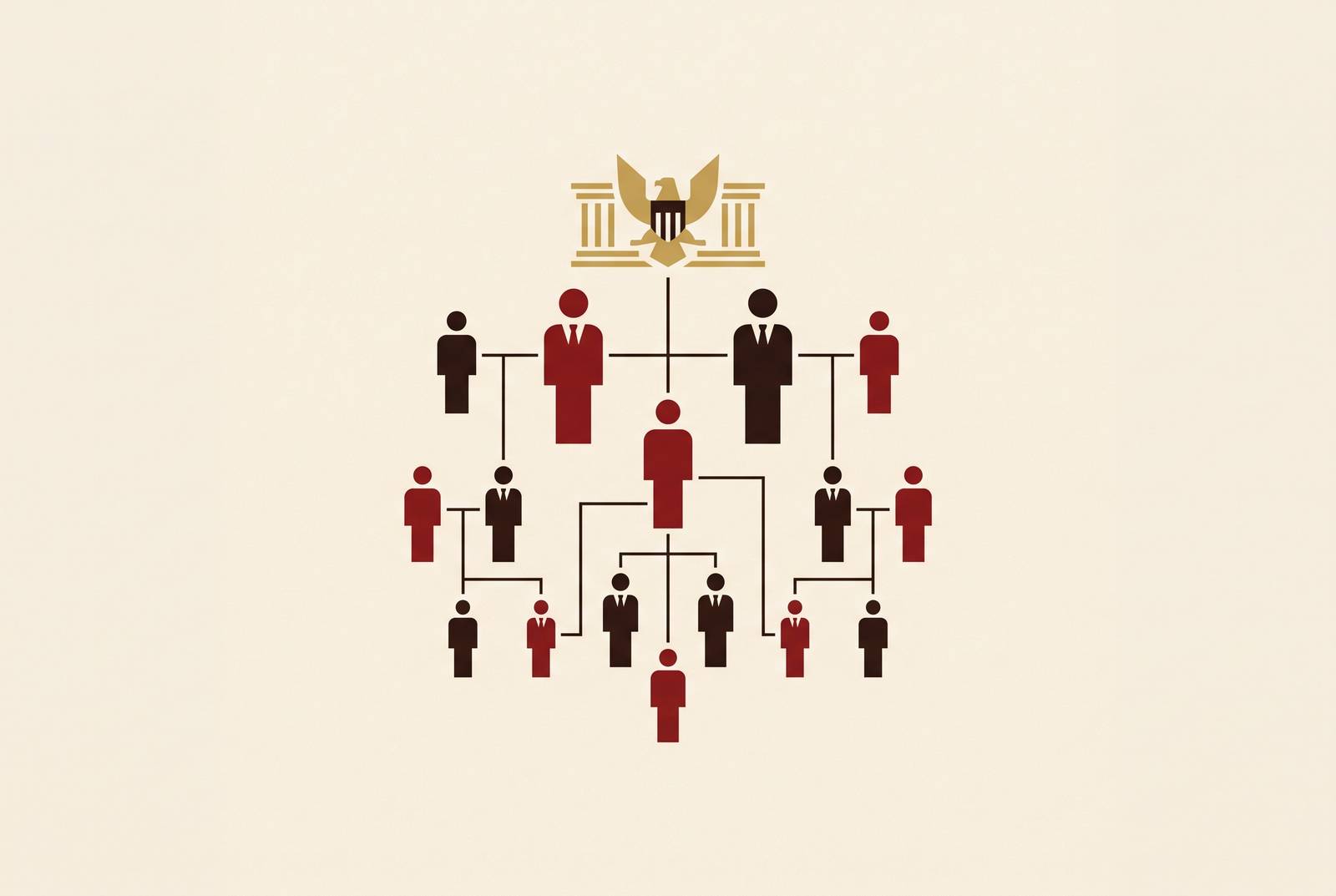
George H.W. Bush entered the vice presidency in 1981 carrying a résumé that reads less like a political career than a checklist of American power centers: congressman, ambassador to the United Nations, chairman of the Republican National Committee, chief liaison to the People's Republic of China, director of the CIA. Each of those posts opened a door into a different room of American governance, intelligence, foreign policy, party organization, international diplomacy, and each room came with its own set of relationships that stayed open long after Bush moved to the next job. That sequence was not a résumé assembled by chance. It was a deliberate accumulation of institutional footholds, each one layered onto the last, so that by the time Bush reached the vice presidency, the family had working relationships embedded across the machinery the Republican Party actually runs on.
The pattern repeated in the following generation, and it repeated in a way that made clear the first instance was no fluke. George W. Bush won the governorship of Texas in 1994. Jeb Bush won the governorship of Florida in 1998. Two of the largest, most electorally significant states in the country came under Bush family leadership within four years of each other, so the dynasty had parallel bases of power before either brother made a run at the presidency. The Bush family is one of only four in American history to produce two presidents, joining the Adams, Roosevelt, and Harrison families, and George W. Bush's election made his father just the second man in history, after John Adams, to see his own son become president. None of that happened by holding a famous name and waiting. It happened by holding offices, building staff networks, and cultivating fundraising relationships that outlasted any single campaign, which is what separated the Bushes from families that merely share a surname.
What the Dynasty's Ideology Was
From 1980 through 2016, the Republican Party ran on a fairly coherent ideological foundation: Reagan-era conservatism, built around an internationalist foreign policy, support for free trade, a hawkish stance on national security, and rhetorical if imperfect loyalty to fiscal restraint. The Bush family did not invent that coalition, but it became the coalition's institutional steward, managing the handoffs between foreign policy doctrine, fiscal policy, and the party's organizational infrastructure across three decades and two presidencies.
The tension built into that inheritance showed up almost immediately. George H.W. Bush's "read my lips" pledge, and his later reversal to raise taxes as part of a deal to control the deficit, became the clearest illustration of the strain between ideological promise and the demands of actually governing, a strain that would follow the family for the rest of its political life. On foreign policy, Bush's instincts proved more durable: he was the first voice in his own circle to push for German reunification inside NATO, and he persuaded Gorbachev to accept a unified Germany in the alliance by June 1990, a diplomatic result that came to define the family's internationalist brand. What made the Bush approach work politically, rather than just diplomatically, was its ability to speak to two audiences inside the same party at once: the business and foreign-policy establishment on one side, and the broader conservative base Reagan had built on the other. The family's network of relationships, built office by office over two generations, functioned as the connective tissue holding those two audiences together. That tissue, not the family name by itself, was the actual source of the dynasty's durability.
Trump's Rise and the Dynasty's Dependence on a Coalition It No Longer Controlled
Donald Trump's 2016 candidacy was not a slow drift away from Bush-era Republicanism. It was a clean break, and Yale law and history professor Samuel Moyn has described it as, above all, a rejection of neoconservatism in foreign policy. The three issues where Trump broke most sharply with the Republican establishment, immigration, trade, and foreign policy, were not scattered grievances. They were the precise areas where Bush-era doctrine had staked its clearest positions, which meant Trump built his campaign directly on the ground the dynasty had claimed as its own.
The dynasty had weathered a warning sign before. George H.W. Bush's 1992 re-election loss, in which he took a historically weak share of the vote, showed the coalition could fracture under the right conditions. But the family survived that defeat because the party's institutional machinery, the committees, the donor networks, the state parties, stayed intact and stayed loyal to the Bush style of politics. In 2016, that machinery itself became the target. Trump did not just want to beat a Bush in a primary. He wanted to dismantle the infrastructure that had kept Bush-style Republicanism in charge of the party for three decades, and he said as much once he had succeeded. At CPAC in 2023, Trump told the crowd: "We are never going back to the party of Paul Ryan, Karl Rove, and Jeb Bush." That was a direct statement that the party Trump had built no longer had room for the Bush governing tradition, delivered by naming the family's own allies as the symbols of what the new party stood against. The Bush family's power had always rested on control of the party's institutional machinery, not on the name alone. Once Trump had rebuilt that machinery, the base, the fundraising networks, the state-level organizing, around himself, the family's decades of accumulated institutional capital stopped translating into leverage.
George P. Bush's defeat as the moment the dynasty's decline became irreversible within Texas
If the 2016 primary exposed the structural problem, the 2022 Texas attorney general race proved it. George P. Bush ran for the office on home turf, in the state his family had once turned into its strongest base, and lost badly to a two-term incumbent running while under felony indictment and facing an FBI investigation. The loss stands as the clearest single data point available for how far the dynasty's standing had fallen.
Set next to 1994, the defeat reads as something close to a reversal of fortune. That year, George W. Bush won the Texas governorship and turned the family name into a dominant force in the state's politics for a generation. By 2022, Texas Republican primary voters rejected the family's chosen heir outright, and they did so with Trump's help: Trump repeatedly and publicly backed Paxton over Bush in the race, so the dynasty's opponent was not simply a popular local figure but the explicit pick of the national party's dominant leader. Political scientist Cal Jillson of Southern Methodist University offered a blunt comparison for what the result meant: "The Bush family name is essentially what the Romanov family name is in Russia, there's still somebody out there claiming to be czar, but nobody's listening." That line is a pointed characterization rather than a verdict to take as settled fact, but it captures something real about the distance between where the family stood in 1994 and where it stood in 2022. George P. Bush had once represented the dynasty's best argument for its own future: a fluent Spanish speaker and the son of a Mexican immigrant mother, introduced to the national stage at the 2000 Republican National Convention as proof the family could widen the GOP's appeal to a changing country. That promise went unmet, and his 2022 defeat left an open question hanging over the family's Texas legacy: whether there was any path back, or whether the dynasty's run in the state that built it was simply finished.
How the Bush institutional network persists despite the electoral brand's failure
That question has a more complicated answer than the Texas result alone suggests, because the Bush family's electoral brand and its institutional infrastructure are not the same thing. The brand has clearly collapsed. The infrastructure has not. The George W. Bush Presidential Center in Dallas, on the campus of Southern Methodist University, continues to operate as an active institution, and it remains the clearest evidence that the family retains resources and platforms well beyond what its recent vote totals would suggest.
Reporting indicates that George W. Bush and his allies have been maneuvering behind the scenes to rebuild influence inside the Republican Party, with a network of Bush loyalists described as positioned to reassert themselves once Trump is no longer the party's dominant figure, a posture that points toward a possible opening around 2028. That reporting describes positioning, not a confirmed strategy with a fixed timeline: a network waiting for an opening has not yet found one, and nothing in the record shows it converting that posture into action. Still, the distinction between a collapsed electoral brand and an intact institutional one carries real weight. A family that has lost its base of voters but kept its relationships, its donor networks, and its platform is in a fundamentally different position than a family that has simply vanished from political life. The Bush network still has somewhere to stand, even if it does not currently have anyone standing behind it at the ballot box.
The 2026 Maine Race as a Test of the Dynasty's Residual Appeal
Jonathan Bush's run for governor of Maine is the dynasty's most direct effort yet to find out whether that remaining institutional standing can be converted back into votes. Maine is close to the best terrain available anywhere in the country for a Bush to attempt a comeback.
Jonathan Bush, 57, is a cousin of George W. Bush and a nephew of George H.W. Bush, and his public identity has little to do with elected office: he co-founded Athenahealth in the 1990s and later started Zus Health. His campaign leans entirely on that background, presenting him as a "disruptor" and "job creator" rather than a political heir, and he has gone so far as to describe himself as "a new kind of Bush," a phrase that amounts to an admission of how much the family name's political value has changed since the dynasty's peak. Maine gives that pitch room to work in ways few other states would. Senator Susan Collins has won repeatedly in a state that leans Democratic, so Maine Republicans will back a moderate candidate even against the broader partisan grain. Colby College political scientist Dan Shea estimates the state's Republican electorate splits roughly 50-50 between Bush-like traditional Republicans and Trump-LePage Republicans, a ratio more favorable to a Bush candidacy than almost any other state primary in the country. University of Southern Maine professor Ronald Schmidt points out that the family name still carries recognition in the state and that Maine Republicans hold "fond memories of the Bush family." As of May 2026, Jonathan Bush was polling in second place in Maine's Republican gubernatorial primary.
The positioning carries its own tension. George W. Bush and Jeb Bush appeared together at a fundraiser for Jonathan Bush in Kennebunkport, and that setting, built around the family's longtime summer home rather than a Maine political venue with broader reach, is exactly the kind of detail that risks reinforcing the dynastic framing the campaign is trying to shed with rural, Trump-aligned Republicans. The broader race underscores how little room any legacy name may have this cycle: three of the gubernatorial contenders, Democrat Angus King III, Democrat Hannah Pingree, and Republican Jonathan Bush, are children of prominent political figures, running in a climate that leans anti-establishment across party lines.
Why the Bush name divides the Republican primary electorate
Jonathan Bush faces an obstacle that goes beyond any single fundraiser or any one state's demographics. Pew Research's June 2026 Political Typology report, drawing on recent surveys, found that almost no respondents in the party's most hardline conservative segment named George W. Bush the best president of the last 40 years, while most chose Trump. That gap shows something beyond a difference in electoral preference: it reflects a wholesale rejection of the governing tradition the Bush name represents among the party's most energized voters. Even in the survey's more moderate "Pragmatic and Polite Right" category, Reagan outpaces George W. Bush by a wide margin, so the Bush brand fails to lead even among the Republican faction it would seem best suited to represent.
University of Houston political scientist Brandon Rottinghaus put the problem this way: Bush-style politics function as "the anti-MAGA," and the "tone and issue profile of most modern Republicans are different from the Bush family politics. Primary voters have spent a decade being conditioned toward a harder-edged conservatism, and the Bush style no longer matches what that conditioning rewards. Democratic strategist Hank Sheinkopf argues that voters generally respond to the quality of a candidate more than to lineage, saying "the evidence is good that voters really often don't care about political dynasties. If Sheinkopf is right, the Bush name might matter less to Jonathan Bush's chances than the broader narrative of decline implies. But Republican primaries are not a neutral setting for testing that claim. Inside a Republican primary specifically, the Bush name functions as a symbol inside an active ideological argument about what the party should be, not as a piece of simple name recognition a candidate can spend down like campaign cash. That means any Bush candidate has to first overcome the name's negative charge with that electorate before voters even get to the point of judging the candidate on personal merit, which is a higher bar than an unknown newcomer would ever have to clear.
Whether a post-Trump Republican Party could give the dynasty's institutional network a second opening
Everything the Bush family has retained, the Presidential Center in Dallas, the loyalist network reportedly positioning itself for a return, the donor relationships built over three decades, only matters again if the Republican Party's center of gravity moves back toward the coalition the Bushes once managed. Nothing in the current record shows that shift happening. The Pew typology data shows a primary electorate that still leans decisively toward Trump rather than the older brand of conservatism the Bush family represents, and the gap holds even among the party's more moderate wing. Jonathan Bush's Maine campaign, running in close to the most favorable conditions the family is likely to find anywhere in the country, still has to run as a rebrand rather than a restoration, built on entrepreneurship rather than lineage, because the lineage carries a cost the campaign cannot afford to ignore.
What the family retains is optionality. An intact institutional network sitting at SMU and a reported posture of loyalists waiting for Trump's influence to fade do not amount to a plan already working. They amount to infrastructure kept in reserve, built on the same logic that produced George H.W. Bush's original rise: occupy institutions, hold relationships, wait for the right alignment of circumstances. Whether that alignment ever returns depends on forces well outside the family's control, chiefly on what shape the Republican Party takes once Trump's direct hold on it ends. The dynasty was built by accumulating institutional footholds one office at a time over two generations. What the record now shows is a family that still holds some of those footholds while having lost the party coalition that once made them valuable, a position that leaves the network intact but its political return entirely unproven.