Global Political Dynasties Compared to American Ones
Dynastic politics thrives wherever weak parties leave voters searching for reliable signals.
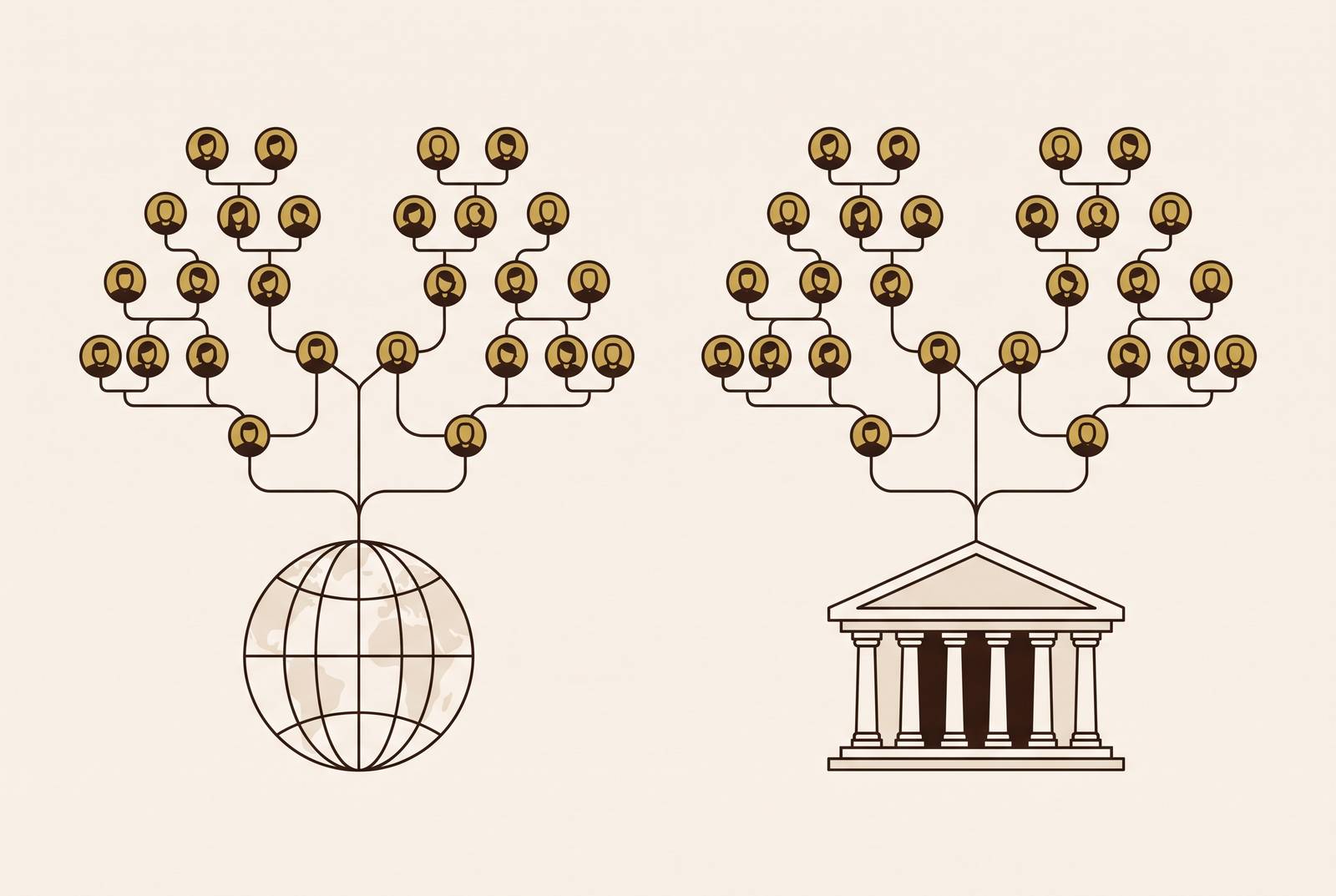
Political dynasties are not a symptom of democratic decay. They are a structural fixture of democratic government at every level of development, from the poorest democracies on earth to the richest ones. A 2025 case study from the Lee Kuan Yew School of Public Policy finds that in well under half of all democracies worldwide, voters have recently elected a head of government who is a relative of a previous ruler, spanning the youngest democracies and the oldest. The countries range from Bangladesh and Malawi to Canada and Iceland, showing that development level does not predict dynastic prevalence.
The definition matters here. In a democratic setting, "dynastic" does not mean a throne passed by decree. It means a blood or marriage relative holding elective office in a past or present administration, someone who still had to win a vote. Scholars distinguish between thin dynasties, where relatives hold office sequentially across different elections, and fat dynasties, where multiple family members hold posts at the same time. Most thin dynasties, given enough electoral cycles, widen into fat ones as a family's footprint across government grows.
If dynasties show up almost everywhere democracy shows up, that universality is the reason the phenomenon deserves close study. That is precisely backward, since the differences between countries, not the universality itself, are what deserve close study. Sorting out why requires understanding what all dynasties have in common before turning to what sets them apart.
The shared mechanisms that sustain dynasties across regions
Every political dynasty, regardless of region, draws on the same basic toolkit: name recognition, patronage, kinship networks, and control over electoral financing. Liu (2026) in the Journal of Education and Educational Research identifies these as self-reinforcing mechanisms, in which each electoral win compounds resources that make the next win easier. That compounding is the entire mechanism. A family does not simply accumulate advantages over time, it converts each advantage into the raw material for the next one.
Brand-name recognition sits at the center of that cycle. Drawing on a framework developed by Feinstein, Liu's analysis treats a familiar political surname as a cognitive shortcut, something a voter with limited information about the candidates on a ballot can fall back on without doing further research. Low-information voters, faced with a choice between an unfamiliar name and a familiar one, tend to default to the name they already recognize, and that default effect does not require the voter to know anything about the officeholder's record.
Patronage turns that name recognition into something durable. Families in office direct public goods (contracts, jobs, infrastructure spending) toward the constituencies that keep them there, and those constituencies learn that loyalty gets rewarded. Kinship networks extend the family's reach well past the officeholder, seeding relatives and allies through the bureaucracy, the judiciary, and local business, so the family's influence outlasts any single term or election loss. Patronage buys loyalty, loyalty sustains name recognition, and kinship networks make sure the infrastructure survives even when a particular family member is voted out. The financial dimension closes the loop. Dynastic politicians tend to win by larger margins and hold greater personal wealth than non-dynastic politicians, and that wealth funds the campaigns that produce the next generation of wins.
None of this is unique to any one country. What differs, sharply, is the environment each mechanism operates in, and that environment is where the real variation across democracies begins.
Weak parties and extractive institutions
South and Southeast Asia host the most pervasive dynastic systems among the world's democracies for institutional reasons. National parties across the region tend to be weak and transactional, built around resource distribution rather than shared policy commitments, and politicians switch parties as power shifts hands. When a party label carries no reliable information about what a candidate will actually do in office, a voter has to look somewhere else for a signal, and a family name fills that gap more efficiently than anything else on the ballot.
The Philippines is the clearest case of this dynamic taken to its extreme. A Christian Science Monitor report found that political dynasties controlled the large majority of the country's provinces, legislative districts, and cities in 2025, and the share of provincial governors belonging to "fat dynasties" has grown markedly since 2004. The 2022 alliance between Ferdinand Marcos Jr. and Sara Duterte put that consolidation on full display at the executive level: two of the country's most powerful and controversial families joined forces and won the presidency and vice presidency by a landslide.
Thailand offers a parallel case under a different constitutional structure. Paetongtarn Shinawatra, former prime minister, is the daughter of former prime minister Thaksin Shinawatra, and a case study uses the Philippines and Thailand side by side to show how dynastic governance operates under both presidential and parliamentary systems. Indonesia's 2024 election of Gibran Rakabuming Raka as vice president fits the same template of dynastic advancement through an executive post.
India complicates the picture in an instructive way. Dynastic politics in India persists because of weak party institutionalization and the entrenched social capital that established political families hold, even as the BJP has positioned itself as an anti-dynasty alternative while nurturing its own dynastic networks at the regional level. That anti-dynasty branding coexists, somewhat awkwardly, with the BJP's own reliance on dynastic networks at the regional level. Opposition to dynasty, in other words, can itself become a kind of dynastic cover, a way of directing criticism at a rival family while quietly building one's own. The Nehru-Gandhi family remains the clearest archetype anywhere of a thin dynasty maturing into a fat one: five generations, three prime ministers, and fourteen elected officials steering the Indian National Congress across most of the post-independence period.
A skeptic could argue this is simply cultural, a matter of societies that defer to family hierarchy. That argument does not hold up well against the evidence. The same cultural traditions of family deference exist in plenty of countries without deep dynastic entrenchment. What's consistently present wherever dynasties dominate is a specific institutional combination: weak parties that cannot signal policy commitments credibly, paired with extractive political economies where control of the state means control of resources. Culture may color how a dynasty presents itself, but the institutional vacuum lets it take root.
What the American case looks like by comparison
American political dynasties are visible, sometimes strikingly so, but they run shallower and more dispersed than their counterparts in South and Southeast Asia. American dynasties are visible at the top but structurally shallower and more dispersed than their counterparts in Southeast Asia or South Asia, and the U.S. is absent from the list of democracies currently governed by a dynastic head of state. Two father-son presidential duos mark U.S. history: John Adams (1797-1801) and John Quincy Adams (1825-1829), and George H.W. Bush from 1989 to 1993 followed by George W. Bush from 2001 to 2009. A case study found that as of April 2025, no fewer than 12 democratic countries had incumbent heads of government whose fathers or husbands previously held the position, and the U.S. was not among them.
Where American dynasties concentrate is Congress and state government, not the presidency. The Kennedys, the Bushes, the Romneys, and the Clintons have functioned far more often as legislative or gubernatorial dynasties than as executive ones. That dispersion traces back to the strength of American party institutions.
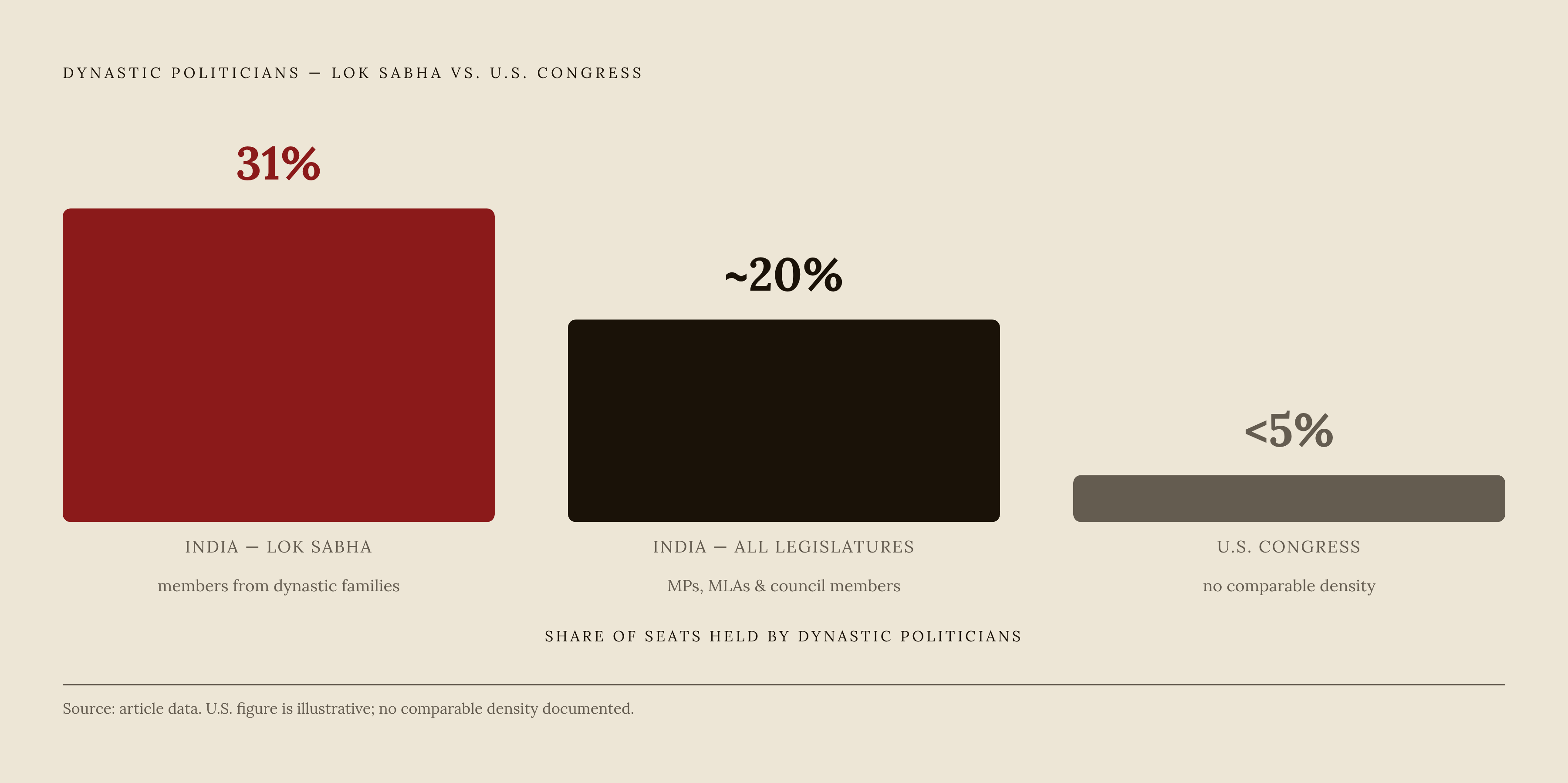
Set against India's numbers, the scale gap is stark. A Grokipedia and Indian Century analysis found that roughly a fifth of sitting members of Parliament, state legislative assemblies, and councils in India come from dynastic backgrounds, a figure that rises to nearly a third, 31%, in the Lok Sabha. Nothing in the U.S. Congress approaches that density of family inheritance.
Some of the perceived American exceptionalism, though, is an artifact of where scholars have chosen to look. A 2025 bibliometric study in Social Sciences & Humanities Open found that the Philippines, the United States, and Indonesia dominate the published academic literature on dynasties in democracies, while advanced European democracies that also have dynastic patterns remain comparatively under-studied. The U.S. looks more unusual than it might actually be, partly because researchers have spent more time studying it and less time studying, say, Belgium or Greece. That gap matters before drawing too firm a line between the American case and everyone else's.
The 2026 American cycle as a live test of dynastic staying power
The 2026 U.S. election cycle offers a live test of whether a familiar surname still moves votes in a political environment defined by polarization and low institutional trust. Axios reported that the 2026 ballots were filling up with members of longstanding political families.
The names involved are specific. Jack Schlossberg, a member of the Kennedy family, is running in New York. Jonathan Bush is running in Maine. Jeanne Shaheen, is a Democratic congressional candidate in New Hampshire's open U.S. House seat primary. Representative Adelita Grijalva was sworn in to the seat her late father, Raúl Grijalva, once held. Robert F. Kennedy Jr. is serving as health secretary in a Republican administration, extending the Kennedy name into the executive branch through an appointed rather than elected role.
What stands out across this list is where these candidates are running. Every one of them is seeking a congressional seat or has entered government through a legislative-adjacent path, not the presidency, which tracks with the broader pattern of American dynasties clustering below the executive level.
Whether name recognition still pays off is genuinely contested. Some analysts treat privileged family backgrounds as a liability with voters who are feeling squeezed economically, arguing that an inherited name signals exactly the kind of insider status many voters are frustrated with. Others argue the opposite: that a recognizable name reads as stability precisely when trust in institutions is low. Culture has supplied a new vocabulary for the skeptics' side of that argument. The "nepo baby" label, imported from entertainment journalism, gives critics of dynastic candidacies a term with real traction among younger voters, one tuned specifically to inherited advantage in a way that has no real equivalent in Philippine or Indian political discourse.
How dynastic alliances collapse
Few events in recent memory have done more to energize anti-dynasty reform than the collapse of the Marcos-Duterte alliance, once the most formidable dynastic partnership in Philippine political history. The alliance came apart over policy disagreements and competing ambitions ahead of the 2028 presidential race. Rodrigo Duterte, 79, was arrested by the International Criminal Court in March 2025 on charges of crimes against humanity. His daughter, Sara Duterte-Carpio, was first impeached by the House on February 5, 2025 on charges including corruption and threatening to kill Marcos, though that impeachment was later voided by the Supreme Court, and a second, successful impeachment occurred in May 2026.
Sara Duterte has offered her own defense of the family's position in politics, one that captures how dynasties everywhere tend to justify themselves: "we have an advantage because of the family name, but it is not our fault that my grandfather was a governor and the mayor is my father... there is an election so people are free to choose." That logic, an inherited advantage framed as simply one input among many that voters are free to weigh, is the standard legitimating argument dynasties make in every system examined here, American ones included.
The Philippine Constitution of 1987 actually directs the state to prohibit political dynasties as defined by law, yet Congress, itself dominated by the families such a law would restrict, has never passed the implementing legislation, nearly four decades later. The Christian Science Monitor reported that the Marcos-Duterte collapse has now spurred a people's initiative movement aimed at finally enacting that ban, with cautious optimism directed at the 2028 elections. The irony is structural rather than incidental: a constitutional ban exists on paper, but the body empowered to enforce it answers to the very families it would need to restrain.
India shows a related pattern from a different angle. The Gandhi-led Congress party has lost repeatedly under Rahul Gandhi's leadership, yet electoral defeat has not dismantled the broader machinery that produces dynastic politicians system-wide. Losing an election weakens one family's grip but leaves untouched the institutional conditions, weak parties and entrenched social capital, that generate dynasties.
The American system faces no equivalent reckoning, for a fairly simple structural reason. U.S. dynasties never needed protection from anti-dynasty legislation, because no legislation of that kind exists to evade. The Philippines has a law it cannot enforce against the people who would have to enforce it. The U.S. has never needed the law to begin with.
What dynasties deliver and to whom across different systems
Whether dynasties are good or bad for the places they govern depends heavily on which level of government you're examining. At the cross-national level, the evidence points in a fairly consistent direction: jurisdictions run by political dynasties show lower standards of living, weaker human development outcomes, and higher inequality compared to non-dynastic jurisdictions. A study in SDGs Review found that dynastic governance structures weaken accountability and lead to non-transparent decision-making and suboptimal public service delivery.
Local-level evidence complicates that picture. A 2024 study by Ternullo, Zorro-Medina, and Vargas in Social Forces examined blocks in dynastic wards in Chicago between 2011 and 2018 and found fewer homicides, assaults, robberies, and thefts there relative to non-dynastic wards. Read on its own, that finding might suggest dynasties can govern effectively within their own turf. Read alongside the cross-national evidence, it refines the critique rather than undercutting it: dynasties can be locally effective precisely because they concentrate resources and attention selectively, directing public safety spending and political capital toward the wards that keep them in office. That selective concentration is the same mechanism that produces inequality at the larger scale. It looks like good governance from inside the ward and looks like resource diversion from outside it.
The Philippine case shows this dynamic in its most extreme form, where the correlation between dynastic control and deprivation is well-documented and pronounced. The Chicago finding likely reflects a milder version of the same underlying dynamic, operating inside a far stronger institutional environment that limits how far the imbalance can run. Put the two cases side by side: institutional strength constrains how far the damage dynasties do can travel, without eliminating it.
Sources
- Political dynasties in the age of democracy: A bibliometric study of global research patterns and future directions - ScienceDirect
- Political Dynasties in Democratic, Developing Countries
- (PDF) Persistence and Decline of Political Dynasticism: Structural Advantage, Social Change, and the Dynamics of Democratic Challenge
- Pelosi, Kennedy families join political dynasties running in 2026