Hollywood Directing Dynasties Across Generations
Three generations reveal how directing talent rarely passes down like other family legacies.
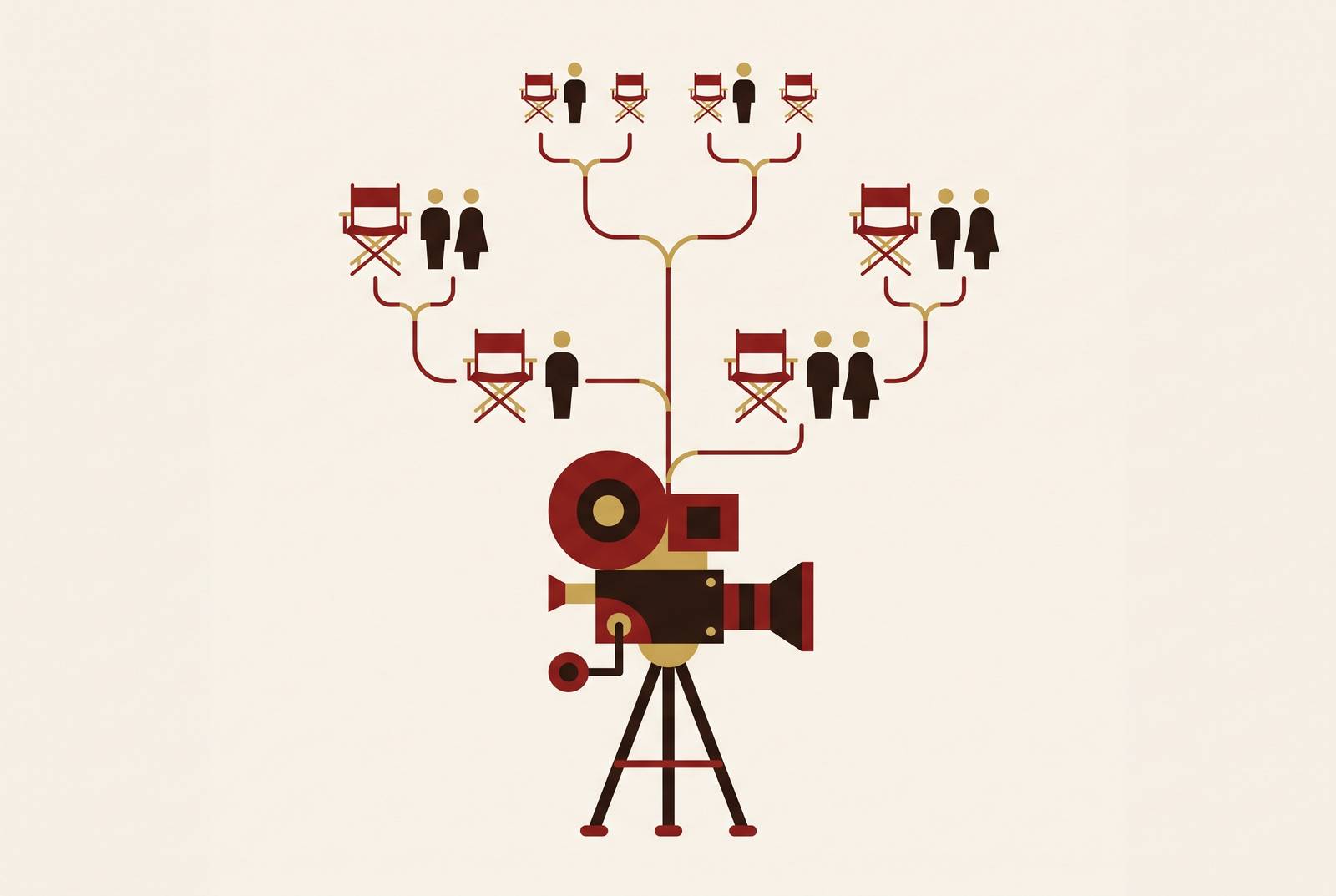
A directing dynasty is a specific thing: a famous last name alone doesn't make one. It requires at least three people, tied by blood or marriage, who each earned real standing in the industry, and it requires that the through-line be directing itself, not acting or composing or producing dressed up as a family business. That distinction matters because directing is the hardest craft in Hollywood to pass down. An actor can inherit a face, a manner, an agent's phone number. A director has to earn something no relative can hand over outright: the trust of a studio to finance a vision nobody has seen yet. What actually moves between generations splits into two separate channels, access and vision, and the story of five families shows how rarely those two travel together.
Access is relationships, reputation, the standing infrastructure of a production company or a distributor's speed dial. It transfers reasonably well, the way any inheritance of professional capital does. Vision, the actual stylistic and thematic fingerprint a director leaves on a film, transfers far less reliably, and the directors who inherit access without inventing their own vision get read, fairly or not, as imitators. The families that follow prove the point differently each time.
The Coppolas: three generations and what transfers across them
The dynasty starts a step removed from directing. Carmine Coppola, who lived from 1910 to 1991, was a composer, not a filmmaker, and the family's cinematic identity had to be built from that foundation rather than inherited from it.
Francis Ford Coppola is the hinge. Across more than 60 years and 23 feature films, he produced a run of work that anchors any conversation about this national cinema, including The Godfather in 1972, The Godfather Part II in 1974, The Conversation the same year, and Apocalypse Now in 1979. Five Academy Awards followed him across his career, including Best Director and Best Adapted Screenplay for Part II. What's notable about his late career is not just its persistence but its financing: Megalopolis, released in 2024, was self-funded, a choice that buys total creative freedom and total financial exposure in the same gesture. The Kennedy Center honored him in 2024, and the AFI gave him its Life Achievement Award in 2025, recognitions that treat his career as a completed argument rather than an ongoing one.
The dynasty is not a straight line from father to son, though. Eleanor Coppola worked as assistant art director on Dementia 13 before becoming a documentarian in her own right, winning an Emmy for Hearts of Darkness: A Filmmaker's Apocalypse. Talia Shire earned two Oscar nominations, for The Godfather Part II and Rocky, and the family's reach extends laterally through Nicolas Cage, Christopher Coppola, and Marc Coppola, siblings and nephews rather than a single descending column.
Among the second generation of actual directors, Roman Coppola made CQ, a film about a filmmaker wrestling with genre pressure, subject matter that mirrors the family's own condition almost too neatly. Sofia Coppola represents the sharpest deliberate break in the whole family. She won the Academy Award for Best Original Screenplay for Lost in Translation in 2003, and her subsequent films, The Beguiled, On the Rocks, Priscilla, work in a register that is intimate, atmospheric, and interior where her father's epics are operatic and vast. She's been described as leading the way for women directors in Hollywood and as having defined a personal style entirely her own, which is another way of saying she inherited access and refused to inherit vision.
Gia Coppola, born January 1, 1987, is the third generation in full, and her career makes the family's real pattern visible. She grew up connected to the family's Napa Valley vineyard, and her feature debut, Palo Alto in 2013, was followed by Mainstream in 2020. The Last Showgirl, released in 2024 with Pamela Anderson, Kiernan Shipka, Brenda Song, Billie Lourd, Dave Bautista, and Jamie Lee Curtis, premiered at TIFF that September and opened domestically. in December, shot in nineteen days in Las Vegas on a budget under $2 million, eventually earning $7.1 million at the box office. Her next film, Perfect, was listed as in development as of September 2025. What connects her micro-budget indie sensibility to her grandfather's self-financed epics is the insistence, shared across three generations of Coppolas, on being the author of the thing rather than a steward of somebody else's material. It's the insistence, shared across three generations of Coppolas, on being the author of the thing rather than a steward of somebody else's material.
The Hustons: what Hollywood's first three-generation Oscar dynasty cost them
Walter Huston, who worked from the stage era through collaborations with directors including Griffith, William Wyler, Josef von Sternberg, and Jean Renoir, won the Academy Award for Best Supporting Actor in The Treasure of the Sierra Madre. His son John directed him in it.
John Huston himself accumulated 15 Oscar nominations across a career that included The Maltese Falcon, The Asphalt Jungle, The Treasure of the Sierra Madre, Key Largo, The African Queen, and Prizzi's Honor, for which he earned a Best Director nomination at age 79, among the oldest nominees the category has ever seen. The structural fact that separates the Hustons from every other dynasty on this list is specific: John directed both his father and his own daughter to Oscar-winning performances, making the family the first in history with three generations of Academy Award winners.
Anjelica Huston's entry into the business came reluctantly, in her father's A Walk with Love and Death in 1969, and her real breakthrough arrived sixteen years later with Prizzi's Honor and a Best Supporting Actress win. The word "reluctantly" carries weight here. It suggests the dynasty exerts a kind of gravitational pull even on family members who would rather orbit somewhere else.
Danny Huston's work, both acting and directing, has been described as carrying the same strength of character and literary instinct that marked John's films, which frames the inheritance as temperament rather than formula, a sensibility rather than a set of techniques. Across the family, careers span more than 75 years at the top of the industry, a run that puts even the Coppolas' own decades-long reach into perspective.
What the Hustons expose, more than any other family here, is the ethical knot at the center of nepotism when the patriarch is also the man doing the casting. When John directs Walter, and later directs Anjelica, the line between genuine creative judgment and family favor is never fully resolvable, and Anjelica's reluctant start is the clearest evidence that the dynasty's pressure runs in more than one direction at once.
The Cronenbergs: genre as dynastic DNA when a third sibling joins unexpectedly
David Cronenberg didn't just work in body horror, he essentially built the genre's modern vocabulary, fusing psychology, flesh, and technology into a body of work that includes Dead Ringers, Scanners, Videodrome, and Crimes of the Future.
His son Brandon Cronenberg has followed a strikingly parallel path: Antiviral in 2012, Possessor in 2020, Infinity Pool in 2023, all science fiction horror with the same visceral, bodily register. Asked about the resemblance, Brandon has said the truth is that he's making movies interesting to him and honest to his own creative impulses, and that people like to see patterns in that, patterns he can't escape even if he wanted to. What makes his case unusual is that he actively avoided directing at first, specifically because people assumed he'd end up there anyway. He didn't enroll in film school at Ryerson until age 24, eventually concluding that resistance on principle was its own kind of trap. Resistance followed by acceptance on one's own terms appears often enough across these families to count as a pattern in itself, not a coincidence unique to Brandon.
Caitlin Cronenberg arrived from an entirely different direction. A photographer who shot the cover art for Drake's Views, she had no plan to direct until an offer from a Schitt's Creek cast member pulled her into it. Her feature debut, Humane, released in 2024, sits comfortably within the family's genre territory, speculative fiction and horror, despite her having arrived there almost by accident.
Taken together, the Cronenbergs form a rare thing: three working directors, one parent and two adult children, active in the same genre lane at the same moment. Whether that's genetic, environmental, or simply the residue of growing up inside a specific aesthetic household, Brandon's own comment suggests he'd resist any tidy explanation. The films, though, make the family resemblance hard to miss. Where the Coppolas spread across epic, intimate, and documentary registers, the Cronenbergs stayed in one lane and let three separate voices develop inside it.
The Reitmans and the Scott family: two structural models for sustaining a dynasty
Ivan Reitman, who died in February 2022, directed and produced the defining comedies of his era: Ghostbusters, Meatballs, Kindergarten Cop, Stripes, and Animal House as producer. more than once and building his career instead through short films and commercials.
The features that followed, Thank You for Smoking, Juno (which earned him an Oscar nomination), Up in the Air, Labor Day, Tully, established Jason as a director with his own tonal register, closer to wry and melancholic than broadly comic. And yet the dynasty eventually closed its loop in the most literal way possible: Ivan handed Jason the Ghostbusters franchise outright, resulting in Ghostbusters: Afterlife in 2021, a torch-passing that made the family structure visible to the public in a way few directing dynasties ever allow. The inheritance ran both directions, too. The inheritance ran both directions in its way: Ivan had built the career Jason spent his twenties trying to avoid, and the Ghostbusters handoff became the clearest sign that the loop had finally closed.
The Scott family took an entirely different structural approach. Ridley Scott founded Ridley Scott Associates, and the company became the institutional home for an entire generation of Scotts: younger family members including directors who came up through the company. Luke came up within the RSA orbit before making his feature debut with Morgan in 2016. Other family members contributed in various capacities to productions under the RSA umbrella. Jordan appeared in a small role in White Squall and did stunt work on Legend in 1985. RSA is the structural key here: it means the dynasty's survival never depended on any single film succeeding or failing, because the company itself is the perpetuating mechanism, not any one director's box office.
Jason Reitman built distance from his father before eventually accepting the family franchise. The Scotts built shared corporate infrastructure from the outset, which meant they never needed distance. Both approaches sustained a dynasty, just through opposite logic. A third variant comes from Barry and Sam Levinson: Barry won an Oscar directing Rain Man, while Sam moved into television altogether, with Euphoria and The Idol, proving that inheritance can also mean changing the medium entirely rather than the genre or the tone.
The Eastwoods, Hustons, and Howards: how dynasty looks when the patriarch's shadow is longest
Clint Eastwood has directed forty feature films across one of the longest careers in Hollywood history. Kyle himself never competed directly in directing, choosing instead a lateral path into film composing and jazz rather than following his father into the director's chair. It's Clint's daughter Alison who carried the directing thread forward, working as an actress, director, and producer, which is a reminder that these lineages don't always run through the child a casual observer would expect.
Ron Howard, who won the Best Director Oscar for A Beautiful Mind in 2001 and directed Apollo 13, Willow, and Splash across his career, has a daughter, Bryce Dallas Howard, whose directing work has gone in a distinctly different direction: episodes of The Mandalorian and The Book of Boba Fett, and the Apple TV+ docuseries Dads, which features Ron himself. Television and documentary format became her territory, separate from the big-budget prestige features that defined her father's career.
Robert Redford's directorial debut, Ordinary People in 1980, won multiple major Academy Awards in a single night, and he went on to direct Quiz Show, A River Runs Through It, and The Horse Whisperer, while also building an institutional legacy separate from any single film he made. Members of the next generation moved into directing and documentary work, extending the Redford name across a third generation in its own quieter register.
What unites the Eastwoods, Hustons, and Howards is the sheer size of the shadow each patriarch casts, and the fact that none of the next generation tried to out-direct that shadow directly. They moved sideways instead, into music, into television, into documentary, into producing, which may be the most honest evidence available that vision inheritance rarely survives head-on competition. It survives translation.
Sources
- Hollywood’s Directing Dynasties: Coppolas, Cronenbergs and More (Photos)
- Hollywood's Directing Dynasties: Coppolas, Cronenbergs and More | Photos
- List of entertainment industry dynasties - Wikipedia
- en.wikipedia.org
- hollywoodreporter.com
- Francis Ford Coppola - Wikipedia
- Sofia Coppola - Wikipedia
- Gia Coppola - Wikipedia