Fashion Model Dynasties in the Supermodel Era
Visibility and money turned modeling into a heritable asset.
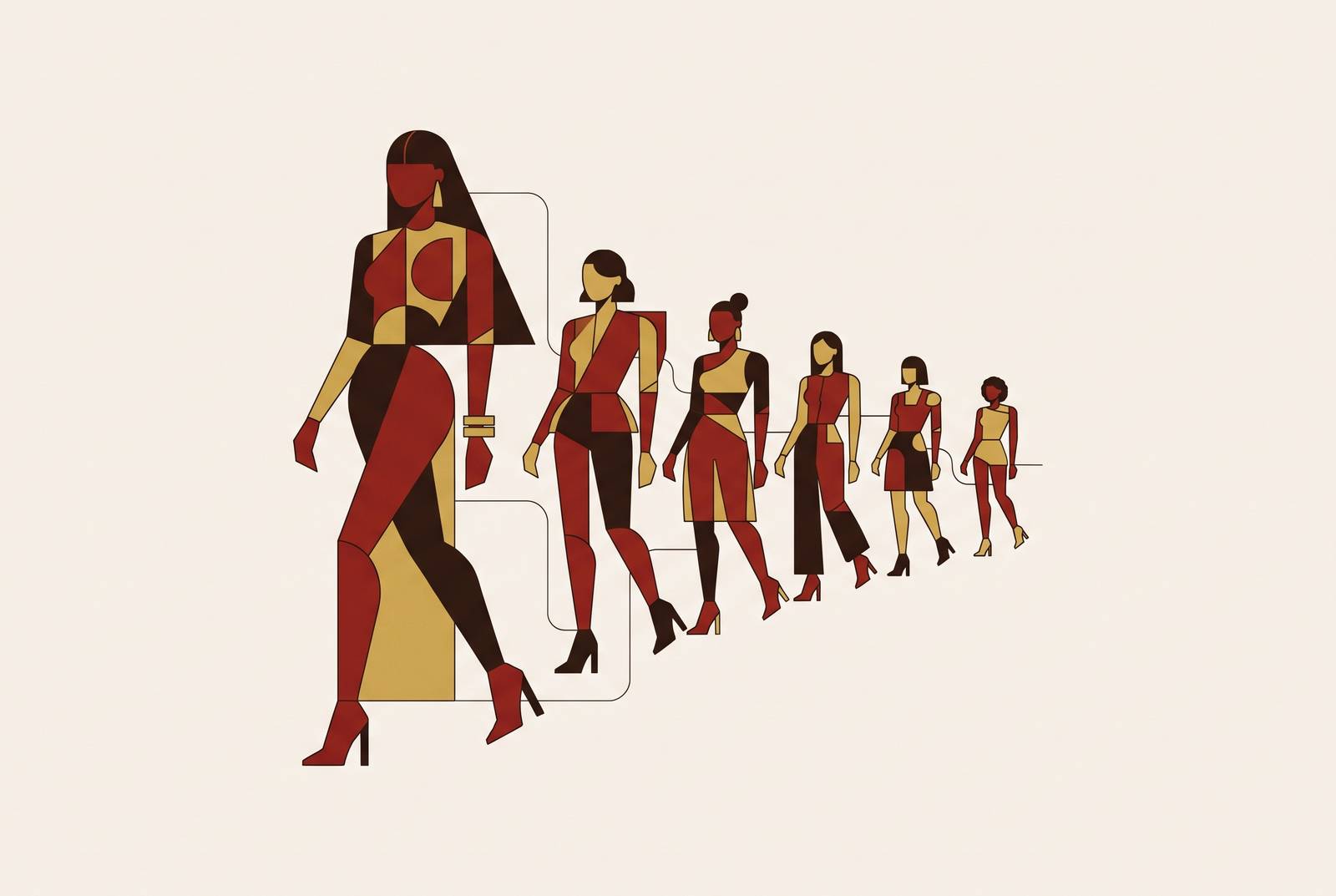
Fashion model dynasties exist because the supermodel era changed what modeling was, not just who was doing it. Before the 1980s, models worked in relative anonymity, moving between jobs without the public recognition that turns a career into a brand. What broke that pattern was structural: agencies like Ford and Elite competed for market share, the global cosmetics industry expanded fast enough to need faces it could repeat across continents, and the public started paying attention to fashion the way it paid attention to film or music. That combination did something specific. It gave a small number of women simultaneous, cross-market visibility, and visibility at that scale is what separates a working model from a supermodel. Claudia Schiffer said being on every cover, in every country, at the same time, was the actual definition, not simply being successful in one market.
Money did the rest of the work. Once earnings became public knowledge, modeling stopped looking like a trade and started looking like a tier of celebrity with its own economics attached to it. Two moments crystallized the shift for good: the January 1990 British Vogue cover with Naomi Campbell, Cindy Crawford, Christy Turlington, Linda Evangelista, and Tatjana Patitz together, and the Gianni Versace Fall 1991 show, where models walked under spotlights lip-synching to George Michael's "Freedom '90". Versace's show in particular deserves the credit the sources give it: pulling a handful of names out of the runway ranks and staging them as icons was the first deliberate act of supermodel-making, the moment a design house decided that a handful of faces were worth more, together, than any single collection.
The supermodel era's chosen clans before blood dynasties
Before anyone passed a career down to a daughter, the industry had already learned how to pass status sideways, into tight, exclusive circles built around specific houses. People talk about nepotism in fashion now without noting that the supermodel era invented the "family" long before it produced an actual family tree. At Alaïa, Chanel, and Versace, small groups of models became the visual signature of the house, and Azzedine Alaïa's models didn't just work for him, they wore his clothes off the clock and called him family, using the language of blood relation for something that was, on paper, a business arrangement. Naomi Campbell, Linda Evangelista, and Christy Turlington went further still, earning the nickname "the Trinity" for how consistently they appeared as a unit, on the runway and off it. Casting director James Scully called it "a perfect cultural storm," and the phrase is apt, because nothing about that convergence was guaranteed to repeat itself.
None of this came from nowhere. Yves Saint Laurent and Halston had already hired models who became inseparable from their design identities, so the practice of a house claiming a face predates the supermodel decade by a good margin. Fashionista's account of the era's visual language matters here too. Models were shot and styled as goddesses, as Eurydices, as Amazonians, borrowing directly from classicism and Golden Age Hollywood to build a mythology around a handful of irreplaceable names. There was no other Christy. There was no other Linda. There was no other Naomi. That singularity is the exact quality that, decades later, would make parentage a genuine asset rather than a vague social advantage: if a supermodel operated as a myth, then a daughter inherits a fragment of that myth before she ever steps in front of a camera.
The Crawford–Gerber family as the clearest demonstration of dynastic inheritance
If the thesis needs one case to stand on, it's Kaia Gerber's. Her career doesn't just resemble her mother's, it retraces it, house by house, in a way that reads less like coincidence and more like design. Kaia made her runway debut at Calvin Klein's Spring 2018 show, days after turning sixteen, at the exact house that Cindy Crawford had defined a generation earlier. From there she moved through Chanel, Versace, and Valentino, the same houses central to her mother's own career, and within a year of her debut she had won Model of the Year at the British Fashion Awards. That's fast ratification compressed into a single industry cycle. That's an extremely fast ratification, and it came from the same institutions that built Crawford's name in the first place.
The houses themselves were explicit about what they were doing. Presley Gerber's path runs in parallel: his first runway was for Moschino in 2016, followed by work with Calvin Klein and Tommy Hilfiger, and in 2018 he appeared in a Pepsi Super Bowl commercial opposite his mother that deliberately recreated her iconic 1992 Pepsi spot. Of everything documented in this family's record, that Pepsi recreation is the single clearest act of dynastic branding on file: the same advertiser, the same imagery, mother and son both present, built specifically to reference and extend a cultural moment that had already happened once. Kaia herself has described the mechanism honestly, without pretending it's pure nepotism and without pretending it isn't there either. Her mother used to joke that if she could book herself for a Chanel campaign instead of Kaia, she would, but Kaia has also been clear that the people she's met through her mother are people she now works with directly, on her own account. Donatella Versace explicitly told Vogue how nostalgic it was working with Crawford on set with Kaia, as the house consciously activated both generations simultaneously.
The Kate Moss–Lila Moss line as a test of whether the dynasty holds without the mother's direct involvement
The Moss family offers a different kind of proof, and arguably a more demanding one. Lila Grace Moss Hack made her runway debut in 2020 at Miu Miu during Paris Fashion Week, already under her mother's own agency banner. Mother and daughter walked the 2024 Victoria's Secret Fashion Show in back-to-back segments and turned up separately on the 2026 Met Gala carpet, distinct careers running on adjacent, overlapping tracks.
The commercial detail buried in Lila's own paperwork is what separates this case from a simple story about a famous surname. She set up a company called Grace Grove in 2021 to handle her earnings, and its accounts showed a one million pound profit in 2024, a figure Hello Magazine points to as evidence the work is converting into real money independent of any symbolic value her name carries. That's the number that answers the obvious skeptic's question before it's fully asked. Still, the arrangement has a social cost that shouldn't be smoothed over. A source told The Sun that other models have given Lila the cold shoulder, despite her visible efforts to avoid special treatment, and the same source put her position bluntly: being Kate's daughter opened doors, but Lila wants to succeed on terms that are hers alone. Kate Moss didn't hand this to her daughter eagerly. She initially discouraged Lila from modeling and told her she wouldn't recommend the profession, which complicates any reading of this as a dynasty built by design from day one, and makes the agency's eventual decision to represent her own daughter a more significant structural choice than it might first appear. In 2025 she starred in campaigns for Gucci, Gap, DKNY, and Converse x Isabel Marant, appeared on three international Vogue covers, and in 2024 fronted a Fendi campaign alongside her mother for the Peekaboo handbag.
Other next-generation figures the sources document and the limits of the dynasty framing
Beyond the two clearest cases, the record gets more varied, and the variation is instructive: it shows which parts of supermodel status actually transfer and which don't. Grace Burns, daughter of Christy Turlington and filmmaker Ed Burns, made her runway debut at nineteen at the British Vogue x LuisaViaRoma show in Italy and later walked for Alberta Ferretti at Milan Fashion Week, but she's also said her mother set a specific age before she was allowed to start, a deliberate gate on the inheritance rather than an open door. Leni Klum, daughter of Heidi Klum, debuted alongside her mother in Vogue Germany in 2021 and went on to open Berlin Fashion Week, walk for Dolce & Gabbana, and front campaigns for Dior Beauty. Clementine Vaughn, daughter of Claudia Schiffer, moved to New York to model and shared a POP Magazine cover with her mother in 2024, though she's said openly that she wants to see the start of success rather than inherit its end, and Schiffer herself has noted her daughter's real ambition is behind the camera, not in front of it.
Some of the record runs the other direction. Sailor Brinkley-Cook walked alongside her mother Christie Brinkley at New York Fashion Week and posed for Sports Illustrated, while her half-sister Alexa Ray Joel chose music instead, releasing an EP and playing festival stages rather than runways. Ever Gabo Anderson, daughter of Milla Jovovich, went into acting rather than modeling, and Ming Lee and Aoki Lee Simmons, daughters of Kimora Lee Simmons, both pursued modeling careers of their own. And some of the record shows no succession. Naomi Campbell has two children by surrogate but keeps their identities almost entirely private, their faces hidden from public view, and Linda Evangelista's son Augustin has not entered modeling.
Why the "nepo baby" objection, while real, misdiagnoses what is being inherited
The nepo baby criticism carries some truth. It's incomplete. Access is unequal: a supermodel mother can produce introductions to agencies, houses, and photographers that no amount of raw talent guarantees on its own. The sharper version of the critique isn't about who gets in, it's about who doesn't, about the working models who never got the callback because someone with a recognizable surname got it instead. Lila Moss's experience with the cold shoulder from peers isn't a footnote to that argument, it's confirmation that the resentment has real weight inside the industry, not just among outside observers scoring nepotism on social media.
But the critique collapses two very different things into one category, and that collapse is the actual error. A "nepo model," in the consultant's framing, is someone with celebrity-adjacent parentage and none of the supermodel infrastructure behind her. A "second-gen super" is someone entering an industrial system her mother helped build, an agency, a house relationship, a photographer's trust, that already exists and already works. Those are not the same inheritance, and treating them as identical erases the distinction that actually explains outcomes. The evidence for that distinction is concrete: Lila's Grace Grove turned a one million pound profit in 2024, which is commercial proof the work stands on its own, and Kaia won Model of the Year within a year of her debut, a judgment made by industry peers, not a gift handed down by her mother's old colleagues. Documentary filmmaker Lauren Greenfield frames the deeper point well: modeling used to be a profession no parent wanted for a daughter, until supermodels became celebrities, at which point parents started thinking it was exactly the profession worth wanting. That's the real inheritance. The real inheritance is not a phone call or a booking, but the fact that the mothers' own celebrity is what made modeling legible as something worth passing down.
The next generation's move beyond modeling into new cultural territory
The clearest sign the dynasty is intact is that it's already outgrowing its original format. Kaia Gerber has moved into film and television, appearing in Bottoms in 2023 and Saturday Night in 2024, and taking a lead role in the FX series The Shards, placing her inside the same broad celebrity ecosystem her mother once occupied through modeling and television rather than scripted acting. That's a continuation of the supermodel pattern, not a break from it: the original supers were never confined to runways either, and they moved across magazine covers, music videos, and advertising the moment the opportunity existed. The casting of The Shards even produced its own strange bit of symmetry. Cindy Crawford and Richard Gere were married between 1991 and 1995, and now Kaia is starring alongside Homer Gere, Richard's son, decades after that marriage ended. This coincidence only looks meaningful in an industry this small and this interconnected, where the same handful of families keep circling back into each other's frame. Whether that convergence means anything beyond coincidence is beside the point. What matters is that the infrastructure built in the 1980s and 90s, the agencies, the house relationships, the mythology of singular, irreplaceable faces, is still operating, still producing careers, and now producing them in mediums the original supermodels never had to conquer to become icons in the first place.
Sources
- The Next Generation of Supermodels Is Coming Home to Its '80s and '90s Roots - Fashionista
- Supermodel | 1990s, Fashion, History, & Facts | Britannica
- Side-By-Side Pics Of '80s And '90s Supermodels And Their Gorgeous Daughters - Women
- supermodel tatjana patitz dead 56 where iconic 90s supermodels now
- The Rise and Fall of The 90s Supermodel — Google Arts & Culture
- The Rise and Fall of the Supermodel - Bellatory
- The Fall of the Supermodel