Political Dynasties in US Senate and Congressional Seats
Family names, not merit, determine who wins elections to Congress and the Senate.
Why the founding generation's republican ideals failed to prevent hereditary political power
Roughly 1,700 of the nearly 10,000 people ever elected to Congress have come from just 700 families. That figure, drawn from a historian's book on America's political dynasties, is the clearest evidence that family power in Congress is not a story about a handful of famous last names. It is a structural feature of how American elections distribute power, one that has waxed and waned over two centuries and is, by most measures, waxing again right now. Congressional history has recorded roughly 400 parent-child pairs and more than 190 sibling pairs, underscoring how early and how deeply family ties embedded themselves in the institution. Dynasty in Congress is not an accident of culture or a fluke of voter preference. It is built into the machinery of how elections get won, and the founders' rejection of hereditary rule never touched the mechanism that produces it.
The revolutionary generation rejected hereditary rule in explicit terms: no titles of nobility, no inherited office, a republic built on the premise that authority would be earned rather than passed down through blood. Yet the first Congress, elected within the same decade as that rejection, already showed a notable share of its membership tied to another member by family. That gap was not hypocrisy. Nobody built a mechanism to close it, because the founders regulated who could appear on a ballot, not who arrived at the ballot already carrying trust.
Elections were, and remain, formally open. No law barred a general's son or a governor's nephew from running for the same office his father held. But openness at the ballot box says nothing about how the social capital that wins elections gets distributed beforehand, and in the early republic that capital sat overwhelmingly with families who already had it. Communication was slow, newspapers were local and partisan, and most voters had no way to evaluate a stranger's character except by reputation, which is itself often just another word for family name. A surname voters already knew, attached to a family already trusted in a county or a state, functioned as the only real information most voters had.
That is the hinge the rest of this story turns on: democratic rules govern who may appear on a ballot, but they say nothing about who shows up already carrying name recognition and a donor list built by a father or a grandfather. The obvious follow-up is what that inherited advantage is actually made of, and whether it can be measured.
Research on why dynastic candidates win at higher rates
It can be measured, and the answer cuts against the explanation most people reach for first. Brian D. Feinstein's 2010 study in Legislative Studies Quarterly built an original dataset covering every candidate in open-seat House contests between 1994 and 2006, and found that dynastic candidates outperformed first-generation politicians by a margin ranging from marginal to as much as 7.90 percentage points. Money and experience are not the explanation. Feinstein tested both directly, fundraising and prior political experience, and both returned null results.
What was left standing looks like a brand-name effect. Voters facing an unfamiliar ballot in a low-information race default to the name they recognize, and recognition itself lowers the risk of voting for a stranger. Feinstein's data showed dynastic candidates scoring measurably higher on likability, independent of their record, their fundraising, or their resume. The name does work that policy positions and campaign spending don't, and that finding alone should unsettle anyone who assumes voters are evaluating dynastic candidates on merit.
A separate line of research, from a group of economists published through a national economic research organization in 2007, went further and asked whether the link between tenure and dynastic succession is causal rather than coincidental. Using instrumental variables, the study found that legislators who serve longer in office are significantly more likely to have a relative enter Congress later, and that the relationship holds up as causal. As reported by Time, a legislator who serves more than one term becomes 70% more likely to have a relative eventually join Congress than an ordinary American. Tenure builds the brand. The brand, once built, transfers to the next generation almost automatically.
How dynastic prevalence has shifted over time
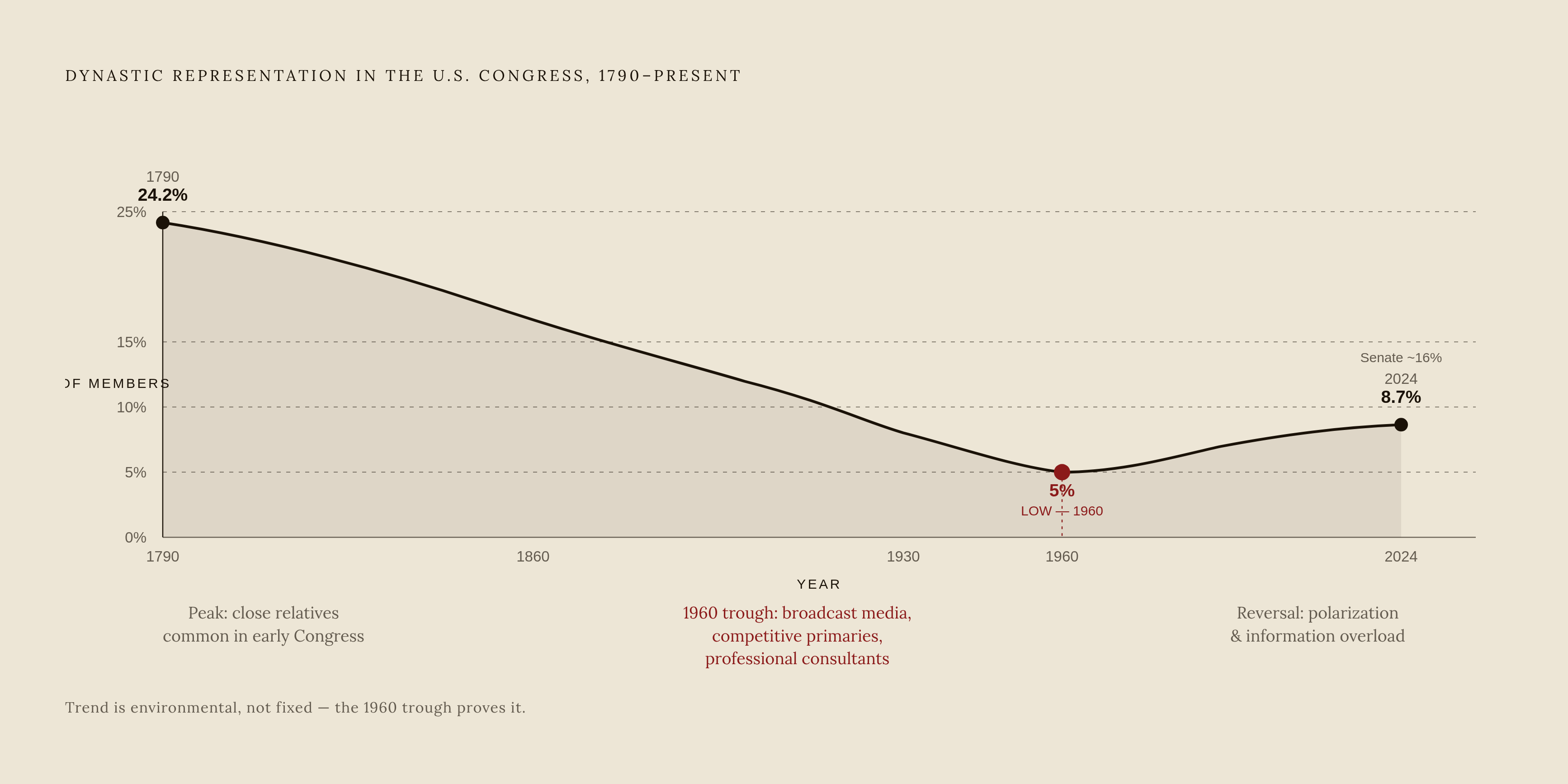
The share of Congress made up of dynastic members has never been static, and its history rules out any theory that treats dynasty as a fixed law of American politics. A 1969 study in the Journal of Politics found that in 1790, 24.2% of members of Congress had a close relative who had also served, a rate not matched since. That number fell steadily across the twentieth century and bottomed out at just 5% in 1960, tracking the expansion of broadcast media, the rise of competitive primaries, and the arrival of professional campaign consultants, all of which gave voters independent ways to evaluate a candidate that didn't run through family reputation.
Since 1960, the trend has reversed hard. Recent years put the figure back near 1 in 10 members of Congress with a close relative who also served in the Capitol, and that number climbs further once state-level offices are counted alongside federal ones. The Dal Bó research puts dynastic membership in Congress overall at 8.7%, with the Senate running at roughly twice that rate, and nearly half of American presidents have had a relative who held political power before them. The 113th Congress offers one snapshot: 31 of 435 House members and at least 25 senators carried a family political history, a data point now over a decade old that a fresh count would likely sharpen rather than soften.
The reversal maps onto the same mechanism that operated in 1790, which is the point people miss when they treat 1960 as some kind of permanent correction. Voters in a polarized, low-trust environment, drowning in information rather than starved of it, reach for the same cognitive shortcut their eighteenth-century counterparts used: a familiar surname substituting for due diligence nobody has time to do. The information environment changed completely. The behavioral response to uncertainty stayed the same. The information environment changed completely.
The Senate's role, more than the House's, as a dynasty incubator
If dynasty is a brand-name effect that compounds with tenure and visibility, the Senate is where the compounding runs fastest, and the House was never built to produce the same result. The Dal Bó research found dynastic concentration meaningfully higher in the Senate than in the House, for structural reasons: six-year terms instead of two, a statewide constituency instead of a district, and a visibility profile that turns a senator's name into a known quantity across an entire state.
The Senate also has a mechanism the House entirely lacks: gubernatorial appointment to fill a vacancy. That mechanism produced the only documented case in American history of a governor appointing his own child to his own former Senate seat. Frank Murkowski resigned his Alaska Senate seat in 2002 after winning the governorship, then appointed his daughter, Lisa Murkowski, to fill it. No election, no primary, no open-seat contest of the kind Feinstein studied. Just a direct transfer of office from parent to child.
That appointment did not happen in isolation. When Murkowski took her seat, she became one of six sitting senators whose parent had also served in the chamber, alongside Mark Pryor (son of David Pryor of Arkansas), Bob Bennett (son of Wallace Bennett of Utah), Evan Bayh (son of Birch Bayh of Indiana), Lincoln Chafee (son of John Chafee of Rhode Island), and Chris Dodd (son of Thomas Dodd of Connecticut). Six senators, at the same time, holding the same job their parent once held. That is the chamber's steady state, not an anomaly it produced once, and the six-year term is exactly the runway the Dal Bó tenure mechanism needs to work.
Four dynasties that show how family political capital compounds across generations
The Bayh family spans three generations and six decades in Indiana politics. Birch Bayh won his Senate seat in 1962, held it through re-election in 1968 and 1974, chaired the Senate Intelligence Committee, and authored both the 25th and 26th Amendments before losing to Republican Dan Quayle in 1980. His son Evan Bayh held the same Senate seat from 1999 to 2011. In October 2025, Evan's son Beau Bayh launched a campaign for Indiana secretary of state, extending the family's political presence into statewide executive office for a third generation.
The Udall family shows that what transfers across generations isn't a district's voter base so much as political capital that moves freely across state lines. The family produced Stewart Udall, who served as Secretary of the Interior under Lyndon Johnson. His son Tom Udall represented New Mexico in the Senate while his cousin Mark Udall represented Colorado in the same chamber at the same time. Former Republican Senator Gordon Smith said: "The Udalls are to the American West, and to Arizona specifically, what the Kennedys are to Massachusetts."
The Kennedys remain the most studied political family in the country, and for good reason. As recently as 2013 the family counted six members with House or Senate service, including members spanning multiple generations of service. In 2026, Jack Schlossberg, grandson of President John F. Kennedy, ran for an open House seat in New York City's 12th district, losing the Democratic primary on June 23, 2026. The loss matters less than what it confirms: a fourth generation of the family stepped onto a federal ballot, and the brand carried him into a competitive primary even without a win attached to it.
The Begich family, out of Alaska, cuts across party lines in a way the other three don't. Nick Begich Sr. entered the House in January 1971 and had six children, including Mark, Tom, and Nick Jr. His son Mark won an Alaska Senate seat in 2008. In the 2026 cycle, a grandson of the original Nick Sr. named Nick Begich III sought re-election to the House as a Republican, while family member Tom Begich ran for governor. One family, competing offices, no shared party line: the brand survives independent of ideology, which is the part the other three dynasties don't demonstrate as cleanly.
The 2026 cycle as a case study in how dynasty reproduces itself at a moment of political disruption
The abstraction turns concrete here. Axios and Punchbowl reporting on the 2026 cycle has flagged a real paradox: in an election defined by populist and anti-establishment rhetoric, the ballot is filling up with political scions at a pace that looks almost old-fashioned. Adelita Grijalva was sworn into her late father Raúl Grijalva's House seat in late 2025 through a special election, a seat-to-child transfer that didn't require an appointment, just an electorate willing to keep the name in office.
The list of 2026 dynastic candidates reads like a syllabus for this entire piece. Jack Schlossberg ran for an open New York City House seat and lost. Stefany Shaheen, daughter of a retiring New Hampshire senator (the first woman in American history elected both governor and senator), ran for an open House seat while publicly breaking with her mother over the vote to end the government shutdown, a split her mother praised as a sign of the daughter's independence. Christine Pelosi, daughter of former House Speaker Nancy Pelosi, ran for a California state Senate seat. Jim Kingston, son of former House member Jack Kingston, ran for his father's old House seat, now held by Buddy Carter, who is himself running for Senate. Tom Begich ran for Alaska governor while his relative Nick Begich III sought re-election to the House. Jake Levine, a former Biden administration official, challenged Representative Brad Sherman for a Los Angeles House seat; his father, Mel Levine, last represented California in Congress in the 1990s.
John Sununu, part of a New Hampshire Republican dynasty running back decades, launched a Senate bid for Shaheen's vacated seat after losing his own re-election bid to her in 2008, setting up a primary against Scott Brown. Jonathan Jackson already holds a House seat, and his brother, son of Jesse Jackson, attempted a comeback bid despite a prior prison sentence for siphoning $750,000 in campaign funds. Beau Bayh ran for Indiana secretary of state. Angus King III, son of independent Senator Angus King, ran for Maine governor and declined to criticize his father's vote to reopen the government during the shutdown, in a crowded field that also included a former Maine House Speaker who was the daughter of a sitting member of Congress and was also running for governor.
The November 2025 shutdown made the paradox impossible to ignore. Two senators, Shaheen and King, cast pivotal votes on reopening the government while their own children campaigned for office and had to publicly stake out positions relative to their parents' decisions. That is the brand-name mechanism playing out in real time, on camera, with the next generation's electoral fortunes tied visibly to choices the older generation was still making.
None of this happens without open seats. Dynastic advantage becomes most visible in open-seat House contests, where there's no incumbent to beat, only a name to recognize, a pattern Feinstein's research documented. The 2026 cycle, with all 435 House seats and 33 Senate seats up for election on November 3, 2026, has an unusually large number of those openings: reporting indicated that a substantial number of incumbent senators and representatives had already announced they weren't running for re-election. Every one of those vacancies is a door, and a familiar surname walks through it more often than chance would predict.
What persistent dynasties mean for voters assessing congressional representation
The comfortable interpretation, that talented families simply keep producing talented politicians, doesn't survive contact with the research. Dal Bó's causal work and Feinstein's brand-name findings both point to the same conclusion: the system rewards inherited political capital on its own terms, independent of a candidate's experience, fundraising, or record in office. Treating name recognition as a proxy for qualification gets the causation backward.
The scale of that reward, tracked across American history, is larger than most people would guess. Researchers have identified 167 families with members elected across at least three consecutive generations, 22 families across at least four, and four families, Bachhuber/Doyle, Cocke, Lee, and Washburn, that have put a member in public office across five consecutive generations or more.
None of this is fixed, and that matters more than the raw numbers do. The drop to 5% dynastic representation in 1960 proves the phenomenon responds to its environment rather than sitting outside it, and the climb back up since then proves the same thing in reverse. Polarization, low institutional trust, and information overload push voters back toward the same shortcut their eighteenth-century predecessors used. Name recognition is not qualification, but it functions as a real electoral force in its own right, separate from money and separate from experience, and that is why the same surnames keep resurfacing on ballots decade after decade.
The 1,700-out-of-10,000 figure that opened this piece means something concrete: roughly 1 in 6 people ever elected to the federal legislature had a family member who served there too. Congress has never been the fully open, purely merit-based institution the civics textbooks describe. It has always run, in part, on inheritance, and the 2026 ballot is just the latest, clearest demonstration of how that inheritance still works.