Kennedy Family Political Offices Across Four Generations
A comprehensive accounting of Kennedy family members in elected and appointed office since 1884.
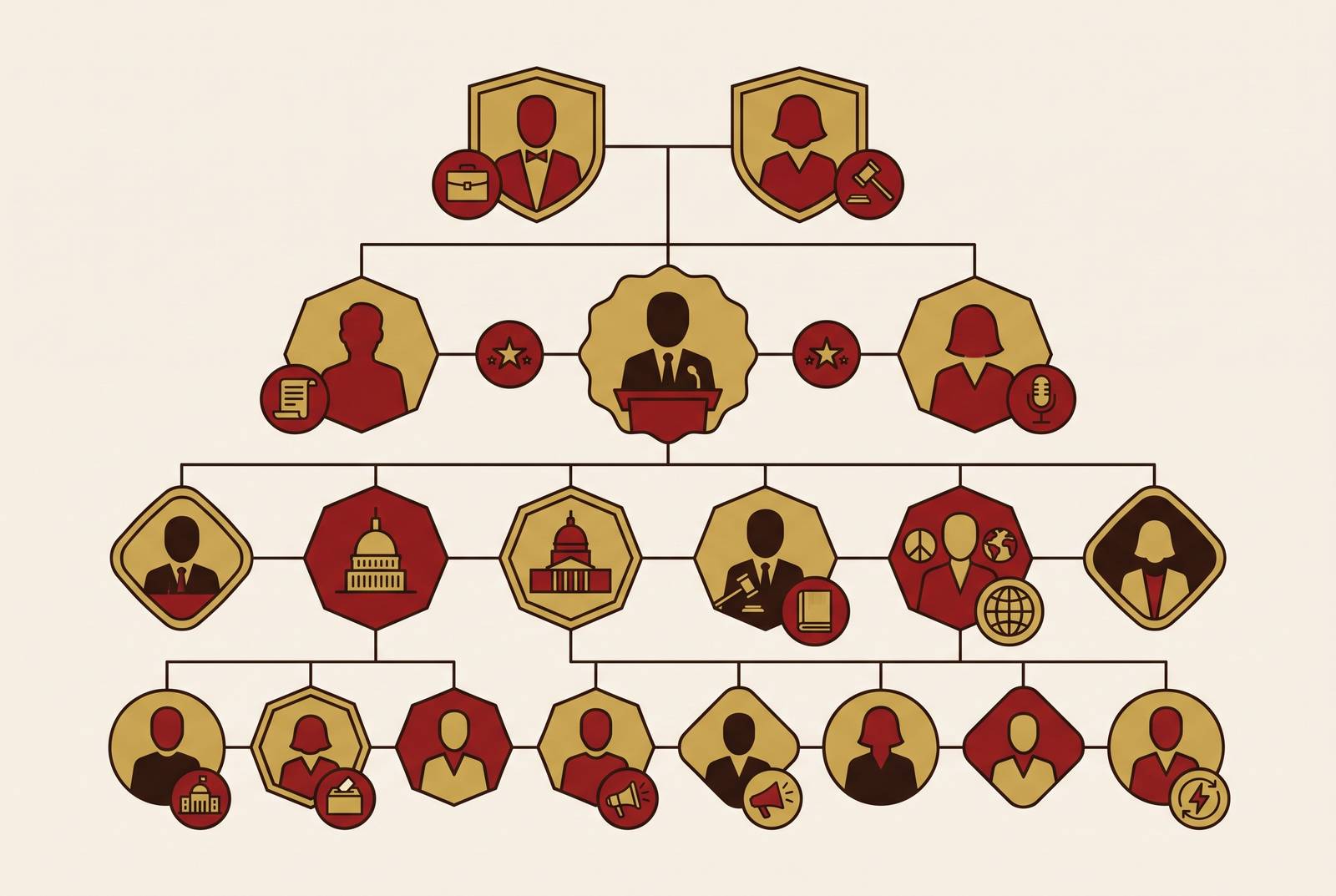
This article is a roster: a generation-by-generation accounting of every major office a member of the Kennedy family has held, from a Massachusetts statehouse seat in the 1880s to a sitting cabinet secretary and a 2026 congressional candidacy. It moves in generational clusters, each with its own level of government, its own party dynamics, and its own mix of elected and appointed roles. The goal of what follows is simply to lay out, generation by generation, who held what, when, and at what level of government, and to let that record speak for itself.
Generation one: P.J. Kennedy in the Massachusetts legislature and Joseph P. Kennedy Sr. in appointed diplomatic roles
The first generation produced one elected officeholder and one appointed one, setting a pattern of both electoral and executive-branch participation that recurs across all four generations. Patrick Joseph "P.J." Kennedy entered the Massachusetts House of Representatives in 1884, the act from which the family's political dynasty is conventionally dated, and he remained active in Massachusetts politics, including a stint as a state senator, until 1895. That entry point did not come from nowhere. The family's rise grew out of Irish Catholic immigrant ambition and the ward-level machine politics of Boston, a specific socioeconomic and ethnic infrastructure that determined which offices were reachable and on what timeline.
Joseph P. Kennedy Sr., P.J.'s son, took a different route entirely, building his political career through appointment rather than election. President Franklin D. Roosevelt named him the first chairman of the U.S. Securities and Exchange Commission in 1934, and shortly afterward appointed him chairman of the U.S. Maritime Commission.
The second generation marks the leap from state legislature and appointed commission chairmanships to the highest levers of federal power, and it remains the most concentrated stretch of officeholding the family has produced. This generation produced a president, an attorney general, a presidential candidate, and the longest-serving Kennedy in Congress, establishing an unbroken federal presence running from 1947 to 2011.
Kennedy, P.J.'s grandson, entered Congress from Massachusetts in 1947 as a member of the House of Representatives, then moved to the U.S. Senate from Massachusetts, where he served from 1953 to 1960. He won the presidency in 1960 and was sworn in as the 35th president of the United States on January 20, 1961. He was assassinated on November 22, 1963, in Dallas, Texas, at age 46.
Kennedy served as U.S. Attorney General under his brother's administration, and after the assassination he ran for and won a U.S. Senate seat from New York. He sought the Democratic presidential nomination in 1968 and was assassinated during that campaign. Smart Politics records his congressional service as spanning well over three years in the Senate.
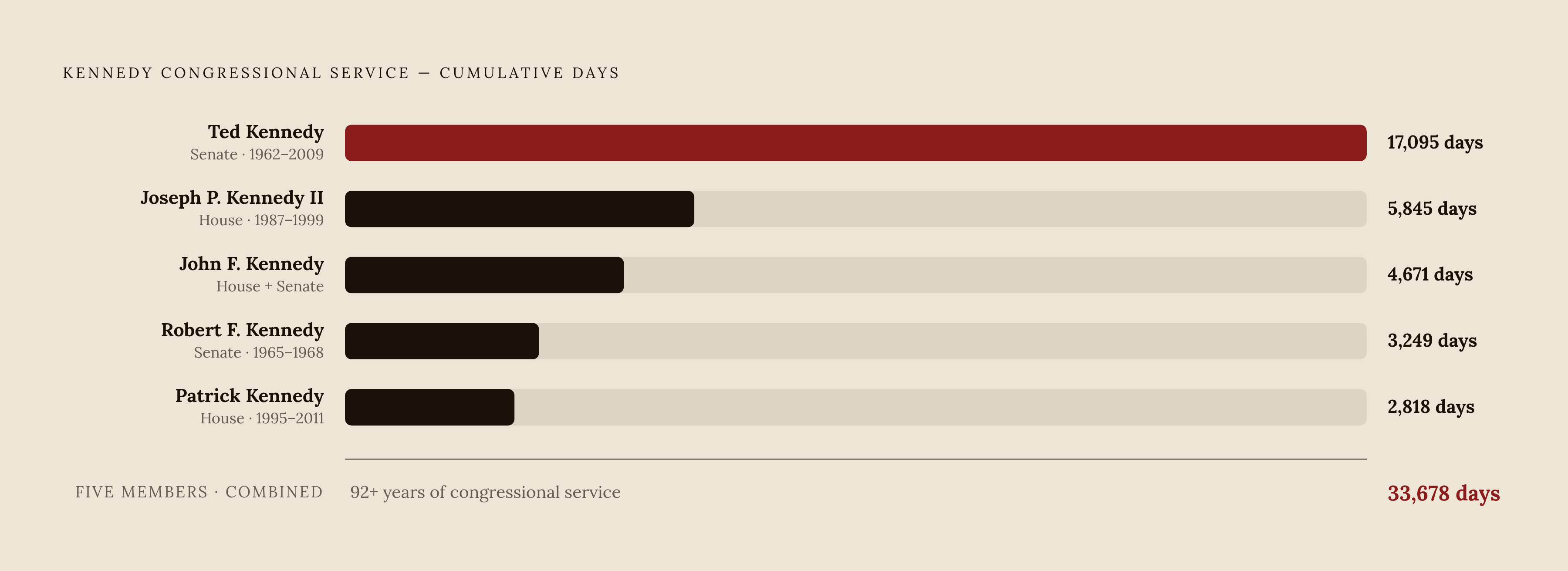
Ted Kennedy's Senate career dwarfs both of his brothers' combined service in sheer duration. He won nine elections to the U.S. Senate from Massachusetts and served there until his death in 2009, having also made an unsuccessful run for the 1980 Democratic presidential nomination. He earned the nickname "The Lion of the Senate" over that tenure, and Smart Politics puts his Senate service at 17,095 days, the single largest contribution to the family's cumulative congressional total.
Generation three: Joseph P. Kennedy II and Patrick Kennedy in the House, Caroline Kennedy and Jean Kennedy Smith as ambassadors
The third generation kept the family's federal elected presence alive through 2011, while broadening its footprint into the diplomatic corps in a way the second generation had not attempted. Joseph P.
Kennedy went on to serve as U.S. Representative from Rhode Island's 1st congressional district from 1995 to 2011, a run Smart Politics tallies at 5,845 days. Smart Politics records his House service spanning more than a decade. His retirement in 2011 ended the family's unbroken run of federal elected officeholding that had begun in 1947.
The third generation's other half is defined by diplomacy. Caroline Kennedy was appointed by President Obama as U.S. Ambassador to Japan, the first woman to hold that post, serving from 2013 to 2017, and she later served as U.S. Ambassador to Australia from 2022 to 2024. In July 2025, she rejoined the Board of Trustees of the United States–Japan Foundation. Jean Kennedy Smith served as U.S. Ambassador to Ireland, extending a pattern of diplomatic appointments that runs from Joseph P. Kennedy Sr.'s post in Britain through her own in Ireland and on to Caroline Kennedy's in Japan and Australia. That pattern matters because it shows the family's diplomatic service is not incidental. The family's internal politics have occasionally surfaced around that same diplomatic lineage: Caroline Kennedy wrote to senators during RFK Jr.'s confirmation process describing him as a "predator," a sign that the dynasty's unity cannot be assumed even among close relatives.
Generation four: Joe Kennedy III in Congress and as Special Envoy, RFK Jr. as HHS Secretary, and Jack Schlossberg's 2026 House bid
The fourth generation picks up where the third left off and spreads across a wider range of government levels and partisan affiliations than any generation before it, with one member sitting in a Republican cabinet, one completing a special-envoy appointment, and one running for Congress in 2026.
Joe Kennedy III served as U.S. Representative for Massachusetts's 4th congressional district from January 3, 2013, to January 3, 2021. In 2020, he lost the Massachusetts Democratic Senate primary to incumbent Ed Markey, becoming the first Kennedy ever to lose an election in Massachusetts. He returned to public service under President Biden, who appointed him U.S. Special Envoy for Northern Ireland for Economic Affairs, a post he held from December 19, 2022, to December 13, 2024.
Kennedy Jr. took the family into territory it had never occupied before. President-elect Trump nominated him for Secretary of Health and Human Services in November 2024, and the Senate confirmed him by a vote of 52-48 in February 2025 amid strong opposition from scientists and medical groups. He assumed office as the 26th United States Secretary of Health and Human Services on February 13, 2025, becoming the first Kennedy to hold a cabinet post in a Republican administration, a break from more than a century of the family's association with Democratic public service. His tenure has drawn significant legal, scientific, and political criticism over his actions on vaccines, public health policy, and agency leadership, a record this article notes as fact without evaluating it further.
Jack Schlossberg, born January 19, 1993, the son of Caroline Kennedy and Edwin Schlossberg and JFK's grandson, ran in 2026 for the New York seat being vacated by retiring incumbent Jerry Nadler in the state's 12th congressional district. He finished third in the Democratic primary. Beyond elected office, the generation's footprint extends into appointed national-security posts: Amaryllis Fox Kennedy, wife of Robert F. Kennedy III, holds roles as Deputy Director of National Intelligence for Policy and Capabilities, Associate Director for Intelligence and International Affairs at the Office of Management and Budget, and member of the President's Intelligence Advisory Board, as of 2025. She is not a Kennedy by birth, and her roles are appointed rather than elected, but she represents the kind of adjacent institutional presence that now surrounds the family's core officeholders.
The family's cumulative congressional record measured against other American political dynasties
Measured purely in cumulative days spent in Congress, the Kennedys hold the longest total congressional service of any prominent American political dynasty, a record built less on sheer numbers of officeholders than on the singular length of Ted Kennedy's Senate tenure. Smart Politics at the University of Minnesota totaled the combined congressional days across five Kennedys: Ted Kennedy's Senate years, Patrick Kennedy's House years, Joseph P. Kennedy II's House years, JFK's combined House and Senate service, and Robert Kennedy's Senate years. That tally comes to 33,678 cumulative congressional days, or more than 92 years of combined service.
Congress is only one axis of the family's reach. The Kennedys have also held office or appointment in state legislatures through P.J. Kennedy, in the diplomatic corps through Joseph Sr., Jean Kennedy Smith, and Caroline Kennedy, in executive-branch appointments through RFK Jr.'s HHS Secretary post and Joe Kennedy III's Special Envoy appointment, and in attempted presidential campaigns, won by JFK and lost by RFK Sr., Ted Kennedy, and RFK Jr.. The Smart Politics totals are the sourced figures to use; present them clearly and move on.
Whether the dynasty is structurally over or continuing in a more diffuse form
The third generation held federal elected office continuously through 2011 and extended the family's reach into diplomacy, with two members serving as the first woman in each of their ambassadorial posts. The strongest evidence that the dynasty has already structurally ended is Joe Kennedy III's 2020 primary loss in Massachusetts, the first Kennedy to lose a home-state election, while the strongest evidence it continues is that three members of the fourth generation hold or recently held federal posts simultaneously.
The Brookings Institution has taken the structural-end position directly, noting that the family now includes 25 third-generation members and more than 50 fourth-generation members, and arguing that any future Kennedy who wants to hold office will have to earn it individually, the way a contemporary Adams or Roosevelt would, because the family name no longer delivers votes on its own. Against that stands the case that the dynasty hasn't vanished so much as changed its mechanism: Caroline Kennedy's board appointments, RFK Jr.'s cabinet seat, and Joe Kennedy III's envoy role all show the family exercising institutional influence that runs parallel to, rather than through, elected office, a more diffuse arrangement that may prove more durable than any single congressional seat.
Jack Schlossberg's 2026 run puts both arguments to a direct test. He ran on the family name in a competitive New York primary and finished third, a result that lines up with the Brookings argument that the name no longer guarantees victory at the ballot box. RFK Jr.'s appointment to a Republican cabinet adds a further complication to any clean verdict: the family's identity as a Democratic institution, built up over more than a century, no longer holds without exception, and that shift changes what "Kennedy political influence" even describes going forward. The roster closes here, with the record laid out and the question of what comes next left open for whoever is counting the days.